Pulled BBQ Chicken: How to Smoke, Rub and Hold It Safely
It's Saturday afternoon, and the chicken thighs have been thawing in the fridge for a smoker session. Before lighting up, decide what the batch needs to do: feed everyone tonight, or leave enough for another meal. That choice shapes how much you cook and what happens after pulling.
Plan the second meal before seasoning the first.
Pulled chicken can go wrong before it reaches the grate: too much meat, no plan for leftovers, a probe left in the drawer. Sauce added too early softens the bark. These are avoidable problems, but they need decisions rather than extra smoke.
I'd plan the batch around the cut, the target, safe holding and a second meal that suits the same rub. Keep the seasoning useful beyond tonight's plate, and give every portion a purpose.
Pulled BBQ Chicken Cuts, Times and Temperatures
Boneless thighs are the simplest starting point for a pulled chicken batch. They stay moist, shred cleanly and let you check the centre without working around a bone. Choose your cut before setting a serving time: the table gives approximate cooking ranges for a smoker running at 120-130°C.
| Cut | Approximate cook time | Target internal temperature |
|---|---|---|
| Whole chicken (1.5-2 kg) | 3-4 hours | 75°C minimum at the thickest part |
| Bone-in thighs | 2-3 hours | 80°C or above for easy shredding |
| Boneless thighs | 1.5-2 hours | 80°C or above for easy shredding |
| Breast crown | 1.5-2 hours | 75°C minimum; pull while still moist |
Thighs give you more room for error. Their connective tissue softens during cooking, so taking them beyond the minimum safe temperature helps the meat separate into strands. Bone-in thighs need more time than boneless, which matters when you're planning the whole batch around dinner.
Breast needs closer attention. It has a narrower window between juicy and chalky, so keep it away from the hottest draught in the smoker and pull it promptly once safely cooked. Don't chase the thigh temperature with breast meat.
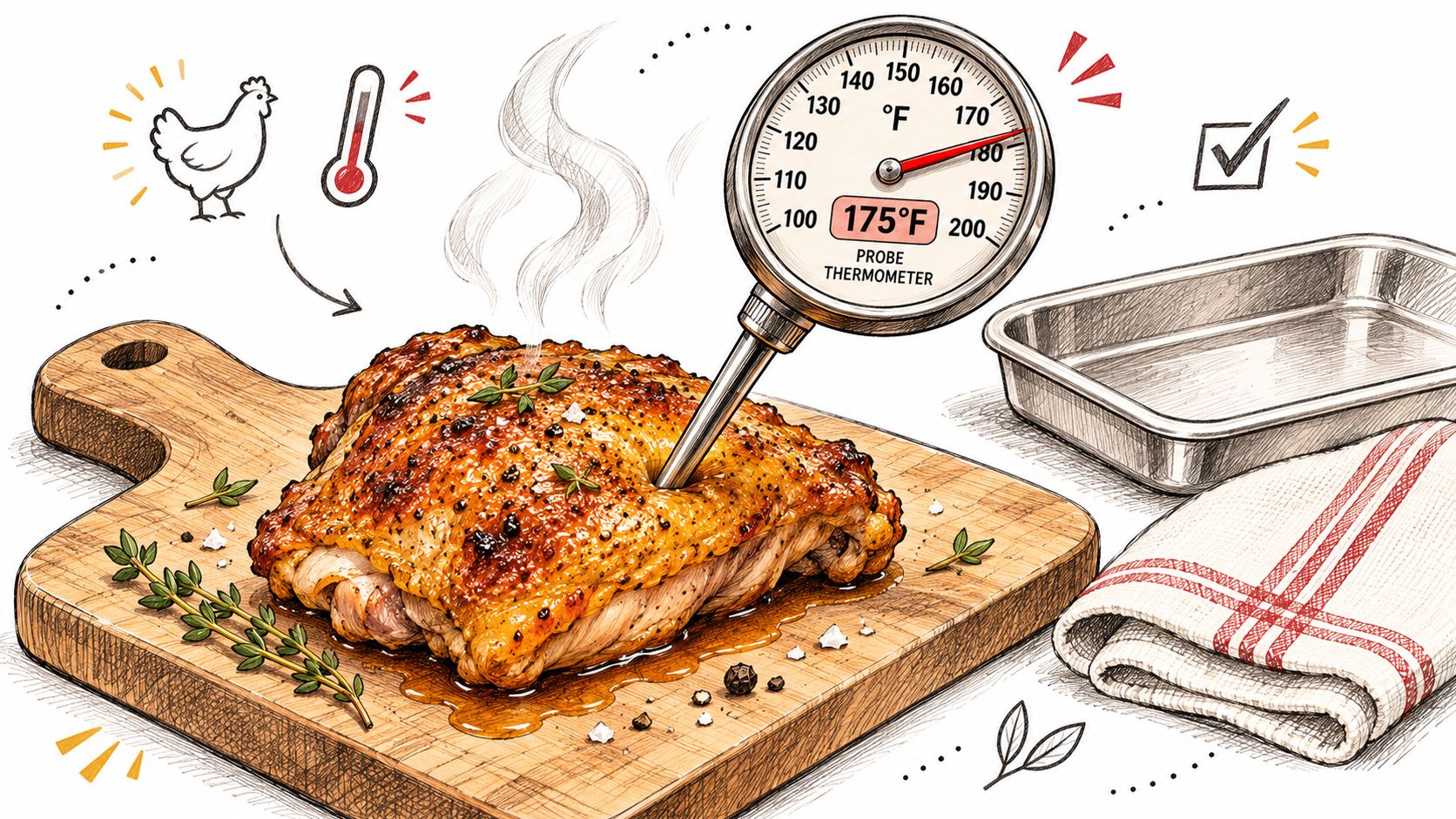
Safety floor: the thickest piece has to reach 75°C at the centre for at least 30 seconds. Higher targets for thighs are about tenderness and easy shredding.
Use the clock to plan, then let the probe decide. Check the thickest pieces rather than assuming the whole batch is ready together. For thighs, the meat should also separate easily with two forks. Cold, breezy weather and a smoker loaded with cold chicken can both stretch the cooking time.
For quantities, I'd allow about 350 g of raw boneless thigh per adult. A 1.5 kg batch feeds four with a little spare, rather than guaranteeing a full second meal. Decide how much you want left before buying the chicken, so tomorrow's lunch is part of the batch rather than whatever survives dinner.
For a first cook, stick with boneless thighs: fewer awkward temperature checks and a more forgiving finish.
Choosing a Chicken Rub for Pulled Chicken
Three things decide whether a rub works on a long chicken cook: how much heat it carries, how much sugar it holds, and how much smoke flavour is already in the blend. Sugar is the one that catches people out. A sweet rub on a two-hour cook will darken and turn bitter long before the meat is anywhere near done.
| Rub | Flavour direction | Best for |
|---|---|---|
| Chipotle Cowboy Chicken Rub | Smoky chipotle heat | Pulled chicken for buns, tacos and wraps |
| SPG Base Blend | Salt, pepper and garlic | A neutral base, or a layer under a bigger rub |
| Cherry Force BBQ Rub | Classic BBQ with fruity sweetness | Traditional pulled chicken sandwiches |
| Wingman Wing Rub | Savoury, crisp-skin profile | Thighs where crisp exterior matters before pulling |
Chipotle Cowboy Chicken Rub is what I'd reach for when the batch is heading into buns, tacos or wraps. The chipotle gives a smoky warmth that survives sauce and slaw, and it doesn't need much help from anything else in the cupboard.
SPG Base Blend does a different job entirely. It's the savoury floor under everything else, which makes it the right pick when you're feeding people who don't want heat, or when you want the chicken to taste of chicken rather than of a spice shop.
Cherry Force BBQ Rub delivers the classic barbecue profile with a fruity sweetness, which is what diners mean when they say pulled chicken. Watch it late in the cook, because that sweetness is the first thing to catch.
Wingman Wing Rub is the savoury option with a crisp-skin bias. It earns its place on thighs you plan to finish skin-side down in a hot pan before pulling, where a sugary rub would burn.
The layering trick
A light dusting of SPG first, then a bolder rub on top, gives you seasoning that reaches the meat plus a flavour layer that sits on the surface. Go light on the first pass. Two heavy layers make the finished chicken taste dusty rather than seasoned.
The rubs do the heavy lifting on poultry. As Dale put it on the Smokey Rebel site, they "gives an awesome flavor for poultry", and that's the standard to hold them to: can you taste the bird and the blend, or just salt?
If the bark is darkening too fast
Sugar-heavy rubs go on for the last hour rather than the first. If you've already applied one and the surface is colouring hard, move the batch away from the heat, wrap it if the skin is set, and finish by temperature. The best chicken rubs guide compares the blends by bird and by method if you want the longer version.
How to Smoke and Pull Chicken Step by Step

A batch of pulled chicken is decided before the lid ever goes down. This sequence is written for boneless thighs, the cut that forgives a long cook, and it scales up to a whole bird on the longer clock from the table above. Cook more than tonight needs while the smoker is running anyway: the fuel cost stays the same, and plain shredded meat gives you options for a second meal later in the week.
- Thaw fully and dry the skin. Defrost in the fridge overnight, never on the counter, then pat every piece dry with kitchen paper. Wet skin steams instead of smoking, and a wet surface makes the rub slide off instead of cling.
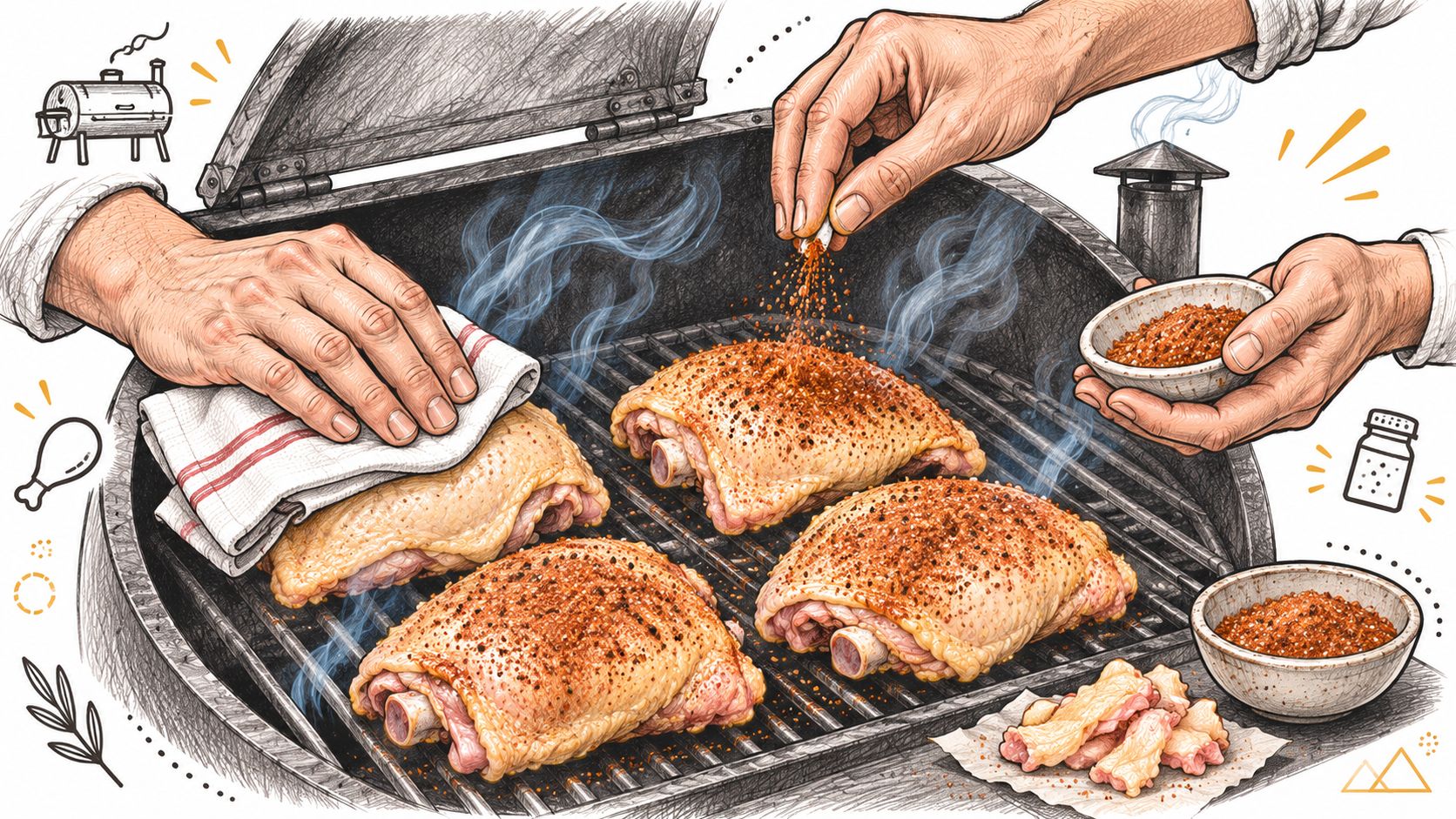
- Trim and season. Cut away loose flaps of fat and ragged edges. Use about 1 tablespoon of rub per 500 g and work it under the skin of the thighs, so the flavour reaches the meat rather than scorching on the surface.
- Rest, then preheat. Leave the seasoned chicken for 30 to 60 minutes in the fridge or somewhere cool while you bring the smoker up to 120-130°C. Clean-burning fuel matters on a two-hour cook; Smokey Rebel's wood pellets contain no fillers, so what you taste is wood rather than binder.
- Smoke it with the lid down. Every time you lift the lid you dump heat and stall the cook. Trust the probe and the clock instead of looking.
- Probe the thickest pieces. Push the probe into the thickest part of each thigh or breast, away from bone, and confirm 75°C for at least 30 seconds at the centre. UK food safety guidance for caterers accepts equivalent combinations of 70°C for 2 minutes or 80°C for 6 seconds, and asks you to verify several pieces rather than trusting a single reading.
- Rest before you shred. Fifteen to twenty minutes under foil lets the juices settle back into the meat. Shred straight off the smoker and you'll watch the best of it run onto the board.
- Dress it while it's warm. Two forks or gloved hands, then a spoonful of the resting juices or your sauce tossed through, not poured over the top. Sauce only what you're serving now and leave the rest plain, so the leftovers can take a different direction the second time around.
If holding 120-130°C steady is new to you, the guide to using a BBQ smoker covers vent control, fuel and the fire management that keeps a long cook boring in the best way.
Where the barbecue fits
The grill is where pulled chicken picks up colour; doneness is the probe's job. The safe pattern for any barbecue cook is the same: get poultry cooked through before it goes anywhere near direct heat, then use the grill for char and sauce so a browned exterior can never stand in for a cooked centre. If the whole cook happens on the smoker, treat the grate as an oven, keep the heat indirect, and don't chase colour at the expense of the middle. No pink meat and clear juices are useful signals, but they back up a calibrated probe rather than replace one.
Here's the whole cook end to end, from the first dusting of rub to the finished tray of shredded meat.
What success looks like: meat that separates into strands under light pressure, clear juices in the tray, and a glossy, slightly sticky bark on the outside. Stringy and wet means it went too long or got shredded cold. Tight and rubbery means it came off early.
Food Safety for Batch Cooking and Holding
Poultry can carry bacteria right through the meat, not just on the surface, so browning on the outside tells you nothing useful about the middle. That single fact is why pulled chicken needs a probe and a written process rather than a good eye and a lifetime of intuition.

| Stage | Limit | Action |
|---|---|---|
| Cook | 75°C for at least 30 seconds at the thickest part | Probe several pieces and avoid bone |
| Cool | Into the fridge within 2 hours | Divide into shallow, small portions |
| Hot hold | 63°C or above | Below 63°C for up to 2 hours: chill to 8°C or below, or discard |
| Refrigerated leftovers | Eat within 48 hours | Reheat only once, until steaming hot throughout |
| Freezer | Use before the use-by date | Label clearly with the date |
The logic behind those limits is simple: bacteria multiply fastest in the warm middle of the temperature range, so every rule here is either about moving food through that band quickly or keeping it out of it altogether. NHS inform's food safety guidance sets out the practical version. Cool cooked food as quickly as possible and refrigerate it within 2 hours, which is why you shred into shallow containers rather than leaving a deep pot on the counter. Keep hot-held chicken at 63°C or above, and if it sits below that for up to 2 hours, chill it rapidly to 8°C or below or throw it out. Refrigerated leftovers are good for 48 hours, reheated once, until steaming hot throughout.
This isn't a theoretical risk. An FSA factsheet on cooking your food reported that 32% of surveyed consumers did not check whether chicken was properly cooked before serving. That's exactly why I'd make the probe check a written line on the batch plan rather than something you remember at the end of a long cook. Clean tongs for raw, clean tongs for cooked, and separate boards for each.
Cook and probe, portion and chill, reheat only what you need.
Any cheap instant-read is enough. The meat thermometer guide covers calibration and exactly where to push the probe, which matters more than the price of the tool.
Turning Leftover Pulled Chicken Into Second Meals
Chicken still ends up in the bin. WRAP's 2025 Household Food Management Survey reported that self-reported waste across four key products, bread, milk, chicken and potatoes, fell from 21% in 2024 to 18.8% in 2025. That's progress, and still a waste problem worth planning around.
The best batch isn't the biggest batch.
Cook for two meals, not a crowd. Estimate portions, keep the sauce separate where you can, and freeze unsauced or lightly sauced chicken in meal-sized bags labelled with the date. The freezer works as a pause button up to the use-by date, not as a place where leftovers go to be forgotten.
Five second lives, each with the thing that stops it tasting like Wednesday's dinner:
- Wraps. Warm the chicken in a dry pan for a minute to crisp the edges, then roll it with slaw and something sharp. The crunch is the whole point. Without it you've made a soft, sweet parcel.
- Jacket potatoes. Split them hot, pile the chicken in, spoon a quick sauce over the top, and add pickled jalapeños or spring onion for an edge against all that starch.
- Rice bowls. Reheat with a splash of water under a lid, then add pickles, fresh herbs and a squeeze of lime. The lime does more work than you'd expect.
- Toasties. Layer chicken and cheese with a little sauce in a hot press. Keep the filling back from the edges or it spills and burns on the plates.
- Nachos. Scatter over tortilla chips with cheese and jalapeños and bake until the cheese melts. Add the chicken for the last few minutes only, so it doesn't dry out.
Every one of those needs something fresh, whether that's sauce, crunch or acidity. Reheated meat tastes flat on its own because the aromatics have gone; a handful of pickled onion or a spoon of slaw puts them back.
The rub is what carries the batch across those meals. A chipotle batch becomes nachos on Thursday and wraps on Friday without eating like the same dinner twice. Thaw frozen portions overnight in the fridge, reheat once until steaming hot throughout, and never refreeze after reheating.
Pick Your Rub and Plan Your Next Batch
One decision gets you started. Choose a rub, choose a batch size that fits your household, and put a date in the diary. Everything else follows from those three.
There are three routes I'd recommend. For a smoky, warming pull that works in buns, tacos and wraps, use Chipotle Cowboy Chicken Rub. For plain, savoury food, or as the base layer under something bolder, use SPG Base Blend. If you'd rather test several chicken rubs before committing to a large tub, the Ultimate Chicken 4-Pack puts four together in one box, and Build Your Own Bundle lets you mix your own combination.
Cost isn't the obstacle here. The BBQ Rubs collection lists 10 chicken rubs and 8 pork rubs, and rubs start from £5.49 each, so trying two or three costs less than a single takeaway for the family.
The one number to remember: 75°C at the centre of the thickest piece.
Checklist before you light anything: rub chosen, thermometer calibrated and within reach, batch sized at roughly 350 g of raw thigh per adult, freezer bags and a marker ready for the leftovers.
For Q4, the Christmas Feast BBQ Rub Gift Set suits a home cook who'll use it, and food and drink gifting is now mainstream, with Mintel reporting that the proportion of consumers buying food and drink as gifts had risen to 81% since 2022. Winter cooking is worth planning for too, since a UK survey reported that 57% of respondents had used a barbecue in winter, according to the Leicester Mercury.
Frequently Asked Questions
Which cut is easiest to pull
Bone-in or boneless thighs. Their connective tissue breaks down slowly, which keeps the meat moist and lets it fall into strands instead of crumbling.
What temperature must pulled chicken reach
75°C at the centre of the thickest piece for at least 30 seconds, probed in several pieces and away from the bone.
How long can pulled chicken stay in the fridge
Up to 48 hours. Reheat it only once, and only until it's steaming hot throughout.
Can I freeze pulled chicken
Yes. Freeze it unsauced or lightly sauced in meal-sized bags labelled with the date, and use it before the use-by date.
Do I need a sauce
No. The resting juices and the rub carry it, and sauce is better added when you reheat or just before serving.
Which rub should a beginner buy
SPG Base Blend for a neutral base, or Chipotle Cowboy Chicken Rub if you want a smoky, warming profile from the very first batch.
Smokey Rebel is a family-owned UK business making small-batch BBQ rubs and seasonings with no fillers, and the chicken range is built for exactly this kind of batch cooking. Pick a rub for your next cook, size the batch for two meals, and keep the probe within reach. Browse the full range of rubs, bundles and pellets at Smokey Rebel.
Join our Mailing List
Sign up and get Smokey Rebel Recipes + weekly recipes straight to your inbox!
Recent articles
Pulled BBQ Chicken: How to Smoke, Rub and Hold It Safely
Smoke, pull and hold pulled BBQ chicken safely with cut-by-cut times, the 75°C check, chicken rubs to try and ways...
Read moreLamb on the BBQ: Cooking Times and Safe Temperatures
Learn how to season, barbecue and rest lamb on the BBQ, with cooking times, probe temperatures and UK food safety...
Read more7 Spicy Salmon Recipes for Bold Home Cooking
Try 7 spicy salmon recipes with distinct heat, cook methods and serving ideas, from citrus rubs to hot-smoked fillets.
Read more