Lamb on the BBQ: Cooking Times and Safe Temperatures
If a lamb chop can be pink in the middle, why can't a lamb burger? That distinction matters more than grill marks when you're cooking lamb on the BBQ. A browned surface tells you the outside has cooked, not that the centre of a kofta or burger is safe.
Good barbecue lamb needs controlled heat, seasoning that doesn't overwhelm the meat, and a probe used in the right place. The cooking times below help you organise the meal, but temperature and hold time decide when it's ready, not the clock alone.
Lamb Cuts and Cooking Times at a Glance
Lamb cuts, sear times and minimum core temperatures
| Cut | Direct sear | Indirect finish | Target core temperature |
|---|---|---|---|
| Loin chops, 2.5cm thick | 3 to 4 minutes each side | None needed if the chosen endpoint is achieved | 60°C held for 45 minutes, or a validated equivalent |
| Rack of lamb, 8 bones | 3 to 4 minutes each side, fat side first | 12 to 15 minutes, lid closed, then check | 60°C held for 45 minutes, or a validated equivalent |
| Butterflied leg, about 1.5kg | 4 to 5 minutes each side | 35 to 45 minutes, lid closed, then check | 60°C held for 45 minutes, or a validated equivalent |
| Lamb steaks, 2cm thick | 3 minutes each side | None needed if the chosen endpoint is achieved | 60°C held for 45 minutes, or a validated equivalent |
| Kebab cubes, 2.5cm | 2 to 3 minutes per side, turning often | None needed if the chosen endpoint is achieved | 60°C held for 45 minutes, or a validated equivalent |
| Minced kofta or burgers, 2cm thick | 3 minutes each side | 3 to 5 minutes if thick, then check | 70°C held for 2 minutes, cooked through |
Treat these cooking durations as starting estimates, not guaranteed finishing times. A cold joint, gusty weather or a thick patch of meat can extend the cook. “None needed” means an indirect finish may be unnecessary, not that probing or a temperature hold can be skipped.
Start with an evenly cut chop
For a first cook, choose the loin-chop row. Even thickness makes it easier to brown both faces without leaving a thick section behind. Keep an indirect zone available even when you expect to cook entirely over direct heat.
A butterflied leg needs more judgement. Open it out before seasoning and check for thick lobes or folded sections. Weight helps with planning, but thickness determines how far heat must travel to reach the centre.
Convenient formats also have commercial traction: AHDB's summer barbecue analysis reports that UK lamb kebab volumes increased 27.5% year on year, while overall lamb volumes declined 3.9%.
Temperature warning: Reaching 60°C briefly isn't the same as completing its required hold. For an ordinary barbecue, a hotter, shorter validated combination is generally easier to manage.
Choose the row for your cut, then use a probe rather than colour to judge the centre.
Prepare, Season and Set Up the Barbecue
Preparation should leave you free to concentrate on the grill. Find the probe, clean serving plate and cooked-food tongs before handling raw meat. Trying to organise them while fat is dripping onto coals usually ends with something burning.
- Keep the lamb cool while you organise. Take it out when you're ready to trim and season, rather than leaving it beside a warming barbecue. There's no need to bring the entire centre to room temperature, and outdoor conditions make a fixed counter-rest unreliable.
- Trim heavy external fat. Leave a thin covering for flavour and protection, but remove loose flaps and thick deposits. Fat that melts steadily is useful; fat pouring directly onto the fire creates flames that blacken seasoning.
- Season the meat, not the tray. Pat the surface dry, apply a light film of oil and press the seasoning onto all exposed faces. If your blend contains salt, don't automatically add another layer. Season joints ahead in the fridge, covered and separated from ready-to-eat food.
- Handle marinades as raw-meat ingredients. Yoghurt or lemon can work well with cubes, but drain off excess before grilling so the lamb browns rather than steams. Reserve a clean portion before adding raw lamb if you want a sauce or brushing mixture; discard the used remainder.
- Build direct and indirect zones. Bank charcoal to one side, or leave a gas burner unlit beside the active cooking area. Preheat thoroughly, then adjust the direct side so it browns meat without immediately scorching the coating. Keep the indirect side clear for finishing and rescuing pieces from flare-ups.
- Set up an orderly cooking area. Clean the grate and wipe it lightly with oil using folded kitchen paper held in tongs, away from flames. Thread evenly sized cubes onto skewers without packing them tightly, and put out a clean plate for cooked lamb.
Make the skewers consistent
A skewer containing a thin scrap, a large cube and a folded fatty piece won't cook evenly. Trim and sort the pieces first, then thread similar shapes together. Cook markedly different pieces separately rather than trying to make one skewer accommodate everything.
Keep raw-lamb utensils on their own tray. A clean serving area is much easier to maintain when raw packaging, marinade bowls and used brushes aren't competing for the same space.
How to Cook Lamb Over Direct and Indirect Heat
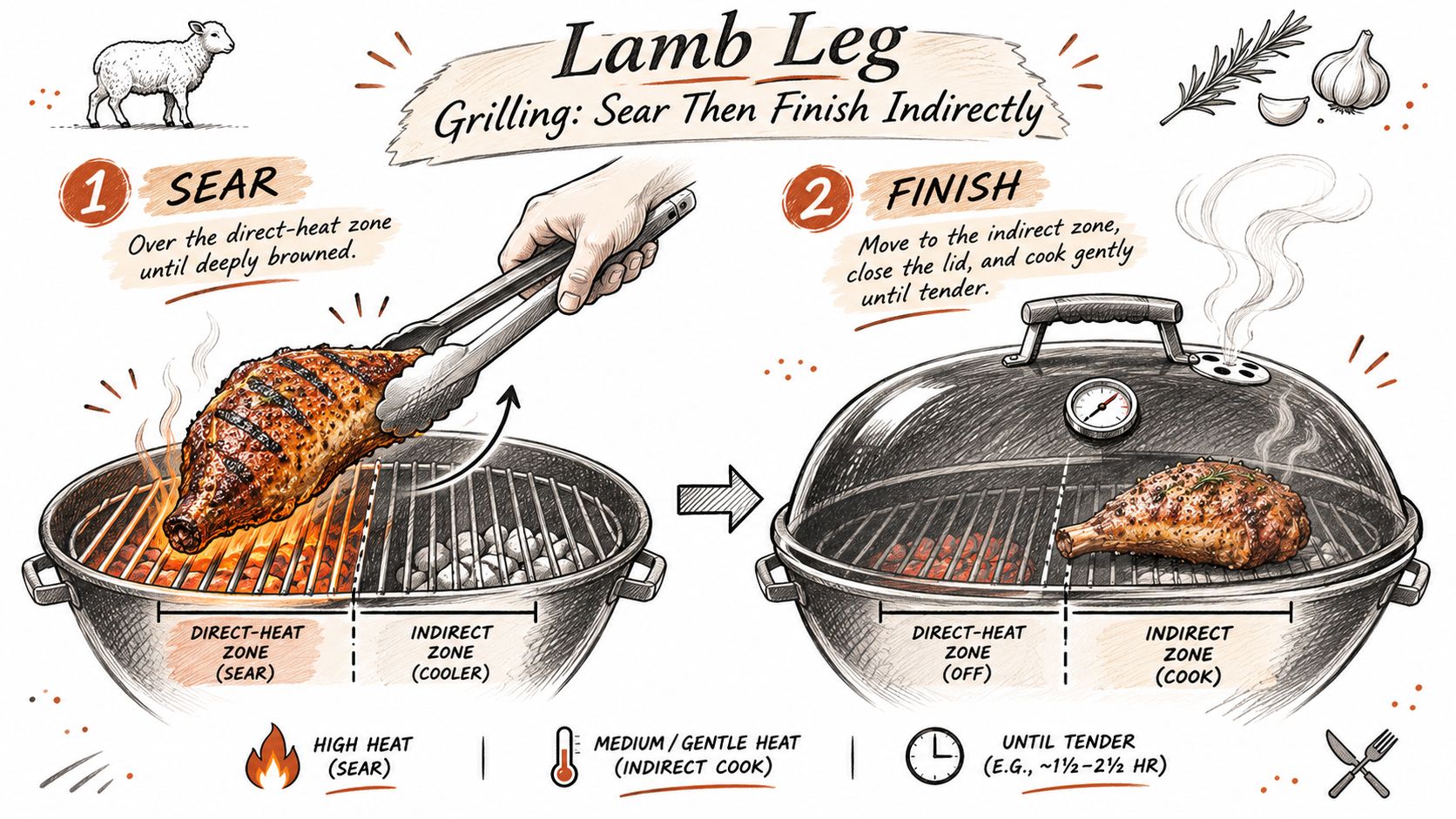
Use the hot side to develop the crust and the cooler side to control the centre. This is particularly important for a butterflied leg, where the thinner edges can finish before the thickest section.
The diagram shows how to separate those jobs.

- Sear without forcing the turn. Lay the lamb over direct heat and let the surface brown. When it releases readily, turn it with tongs. Sear exposed edges too, rather than treating grill marks on the broad faces as sufficient.
- Move before the crust burns. Transfer thicker cuts to indirect heat and close the lid. Thin chops may finish over direct heat, but move them if the outside is colouring faster than the centre is heating.
- Compensate for hot spots. Rotate joints during the indirect finish and turn skewers regularly. If one end cooks faster, reposition it rather than repeatedly exposing the slower end to fierce flames.
- Probe the actual centre. Insert the probe horizontally through the side of a chop or kebab cube. For a joint, check its thickest section and other substantial lobes, avoiding bone and the grate.
Finish by measurement
Don't remove lamb because it has touched the lowest temperature in the table. Complete the chosen temperature-and-hold combination. Carry-over cooking can raise the centre during resting, but you must measure it rather than assume it will happen.
- Rest on a clean platter. Loosely cover joints so they stay warm without trapping enough steam to soften the crust excessively. Resting lets the meat settle before carving, but it doesn't automatically complete a safety hold.
- Carve across the grain. Identify the direction of the muscle fibres before slicing a leg. Cut into manageable sections if the grain changes direction.
For broader grill control, our BBQ cooking tips explain the habits that make outdoor cooking more consistent.
Watch the cooking technique alongside the direct-and-indirect setup.
Your finishing check is simple: browned exterior, verified centre, completed hold and a clean plate ready for serving.
Safe Core Temperatures for Whole Cuts and Mince
Brown doesn't mean cooked through. A kofta can develop a dark crust while its centre remains undercooked, especially when it's thick or placed over very hot coals.
The Food Standards Agency's safer food guidance gives 70°C for 2 minutes as a recommended cooking benchmark, with the equivalent temperature-and-hold combinations shown below.
Core temperature and hold time combinations for lamb
| Core temperature | Hold time | Where it applies |
|---|---|---|
| 70°C | 2 minutes | Benchmark for all lamb, mince, kofta and burgers |
| 75°C | 30 seconds | Validated equivalent for probed lamb |
| 80°C | 6 seconds | Validated equivalent for probed lamb |
| 65°C | 10 minutes | Validated equivalent for slower finishes |
| 60°C | 45 minutes | Validated equivalent for low-temperature finishes |
The hold begins when the centre reaches the stated temperature. Time spent warming towards it doesn't count. A single flash of the target on the display isn't evidence that the full hold has been completed.
Whole cuts aren't the same as mince
An intact chop or steak can be served pink when every external surface has been thoroughly cooked. That exception reflects where contamination is normally expected on an intact cut. It isn't permission to leave an edge, crevice or exposed underside unseared.
Mincing distributes material from the surface throughout the meat. Burgers, kofta and skewered minced lamb must therefore be cooked through, not treated like intact steaks. Rolled joints also need thorough cooking because previously exposed surfaces can end up inside.
For ordinary home barbecue cooking, use the benchmark for mince rather than trying to maintain a delicate low-temperature hold. Our meat thermometer guide helps with probe selection and accurate placement.
A pink whole-cut exception is not a pink-burger rule. Shape, browning and the name of the dish don't change that distinction.
Keep cooked lamb separate
Use separate boards and utensils for raw and cooked food. Never return finished lamb to its raw-meat plate, and keep raw marinade and drips away from salads, bread and serving dishes.
Clean the probe between checks, especially after testing an undercooked piece. Check more than one burger or kofta when their thickness or position on the grill differs.
If a kofta looks brown but hasn't completed the benchmark or a validated equivalent, it isn't ready to serve.
Fixing Burnt Outsides, Raw Centres and Flare-Ups
A charred exterior with a cold centre usually means the lamb has spent too long over intense direct heat. More flames won't correct it. Move the meat away from the fire and give the centre time to cook without destroying the crust.
Lamb barbecue symptoms, causes and fixes
| Symptom | Likely cause | Fix |
|---|---|---|
| Charred outside, raw centre | Whole grill on high heat with no indirect zone | Sear briefly, then move to indirect heat with the lid closed |
| Dry, grey chops | Overcooked, or carved straight off the grill | Stop at the verified endpoint and rest before slicing; don't rely on an assumed temperature rise |
| Flames on the meat | Too much fat over the fire | Trim excess fat and move the lamb off the flame |
| Uneven kebabs | Cubes cut to mixed sizes | Cut to the same size and rotate often |
Change the heat before changing the seasoning
Burnt spices don't necessarily mean the rub is unsuitable. A heavy coating, wet marinade or aggressive fire can scorch the surface before the meat cooks. Use a lighter, even coating and move the lamb as soon as browning becomes blackening.
For flare-ups, lift the food into the indirect zone. Don't leave it suspended over flames while deciding what to do, and don't spray water into hot fat or charcoal.
The FSA's assessment of meat-handling and cooking risks identifies inadequate cooking, temperature control and raw-meat handling among recognised food-safety concerns.
Useful grill note: Record the cut, thickness, grill setting and final core reading. “Lamb took longer” tells you much less than knowing which part stayed cool.
Sear control and more even cutting improve the next cook immediately. Learning where your particular grill runs hot takes repeated use, so change one thing at a time.
Choose Your Rub and Plan Your Next Lamb Barbecue
What flavour suits the way you plan to serve the lamb? A chop eaten from the bone calls for a different seasoning choice from lamb tucked into flatbread with yoghurt and salad.
Chops, racks and butterflied legs
For these cuts, use SPG Base Blend. Salt, pepper and garlic give the lamb a straightforward seasoning without masking its flavour. Apply an even coating over the meat and edges. A thick crust can scorch during searing.
For cubes and kofta, choose Greek Odyssey Gyros Rub for Greek-inspired skewers and flatbread wraps. Coat the cubes evenly. Mix seasoning through kofta mince before shaping, so the flavour runs through the meat rather than sitting only on the surface. A browned exterior does not confirm that minced lamb is safely cooked, so check the centre with a probe.
Smokey Rebel's approach combines authentic cultural flavours with plant-based ingredients, no fillers and recyclable packaging. BBQ rubs start from £5.49 each. The rubs suit smoking, grilling and oven cooking, as well as use in pans, air fryers and slow cookers.
The wider range includes Cherry Force BBQ Rub, Hickory Hog Pork Rub, Wingman Wing Rub, Revolution Beef Rub, Chipotle Cowboy Chicken Rub and Al Pastor Taco Rub. For lamb, choose a clear flavour direction rather than layering several blends. The best seasoning for lamb guide can help you compare options.
Make the next cook straightforward
These blends also suit a Sunday or Christmas roast lamb joint. To select flavours for outdoor cooking and winter meals, use Build your own bundle.
Keep the plan practical:
- Pick the cut. Match its thickness and shape to the cooking table.
- Season ahead. Keep the meat in the fridge and prepare clean serving equipment.
- Sear, then control the finish. Keep an indirect zone available.
- Probe and hold. Check the centre and complete the chosen safe endpoint.
- Rest before carving. Serve on a clean platter with the accompaniments ready.
Frequently Asked Questions About Lamb on the BBQ
What is the best cut of lamb for a first barbecue?
Loin chops or evenly cut lamb kebab cubes are practical starting points. They're easy to turn, portion and check individually, and may not need an indirect finish if they reach the chosen endpoint during direct cooking. Keep a cooler zone available regardless.
Can I eat lamb pink on the barbecue?
Intact whole cuts can be pink when all external surfaces are thoroughly cooked. Minced lamb, kofta and burgers don't qualify for that exception and must be cooked through using the benchmark or a validated equivalent. A brief reading at the lowest temperature in the table isn't a completed hold.
How long does a leg of lamb take on the barbecue?
For the butterflied-leg example in the cooking table, allow for both searing and a substantial lid-closed indirect finish. Check the thickest lobes rather than relying on weight alone. A bone-in or rolled leg needs a different cooking plan, so don't apply the butterflied timing to it.
Can I cook a Christmas lamb joint on the barbecue?
Yes, provided you can maintain controlled heat outdoors and check the centre accurately. Use the same direct-and-indirect approach, keep the lid closed during finishing and allow flexibility for cold or windy conditions. A salt, pepper and garlic seasoning suits a roast-style serving with potatoes and vegetables.
Do I need a probe?
Yes. Colour can't confirm the centre temperature, and pressing the meat doesn't verify a safety hold. Use a clean probe in the thickest section and check separate pieces when their size or cooking position differs.
Smokey Rebel offers small-batch BBQ rubs and seasonings for lamb chops, Greek-inspired skewers and roast joints. Visit Smokey Rebel to choose your seasoning or build a bundle for your next barbecue, then get the grill zones and probe ready before the meat goes on.
Join our Mailing List
Sign up and get Smokey Rebel Recipes + weekly recipes straight to your inbox!
Recent articles
Lamb on the BBQ: Cooking Times and Safe Temperatures
Learn how to season, barbecue and rest lamb on the BBQ, with cooking times, probe temperatures and UK food safety...
Read more7 Spicy Salmon Recipes for Bold Home Cooking
Try 7 spicy salmon recipes with distinct heat, cook methods and serving ideas, from citrus rubs to hot-smoked fillets.
Read moreHow to Cook BBQ Cauliflower Wings
Cook BBQ cauliflower wings on the grill or in the oven. Season, coat and glaze so they stay crisp, with...
Read more