
Pulled Pork Rub UK: The Complete Buyer's Guide
The espresso is barely poured when the delivery box lands on the kitchen counter. Beside it sits a 2kg pork shoulder, a tin of rub, a spray bottle of cider vinegar and a kettle barbecue that still has charcoal left from last weekend. You've got a decision to make. Do you commit to the Weber, keep the temperature steady and accept a long day, or put the pork in the oven at 150°C while the kids are at football?
Every UK cook knows the final wobble of confidence. Ten minutes before the guests arrive, the buns are warming, the sauce is open and the pork is ready to pull. Then you wonder whether the rub was too sweet, too salty or just the wrong choice for the oven.
This guide gives you the straight answer. You'll learn which pulled pork rub suits a smoker, kettle, oven or air fryer, how temperature affects bark, how to read a label for clean ingredients, and how to choose a practical product without getting lost in barbecue jargon.
The Saturday Setup Every UK Pitmaster Knows
Pulled pork doesn't demand an offset smoker. It demands patience, a suitable rub and a reliable way to measure the meat. A kettle barbecue works. A domestic oven works. An air fryer has a role too, although it's mainly useful for reheating pork that's already cooked.
The rub still matters in every setup. A smoker gives you a long period for smoke, drying and bark formation. An oven gives you consistency but less smoke character. A kettle sits between the two, adding live-fire flavour while asking you to manage the charcoal and airflow. Your seasoning should work with that environment rather than fight it.
Practical rule: Choose the cooking method first, then choose the rub. Don't buy a seasoning because the label sounds tough and hope it behaves in the oven.
For a dependable starting point, a pork-specific blend such as Hickory Hog Pork Rub makes more sense than using a beef or chicken seasoning on a shoulder. A pork rub should bring enough salt and spice to stand up to a fatty cut without turning the outside harsh during a long cook.
The UK category is substantial enough to give home cooks plenty of choice. The UK BBQ seasoning market was measured at USD 0.2 billion in 2024, with a projection of USD 0.25 billion in 2025 and USD 0.4 billion by 2033, according to market data on UK BBQ seasoning. The same source links growth with outdoor cooking, food festivals and interest in natural, organic and artisanal products.
That matters because pulled pork rub is no longer a specialist purchase for smokehouse hobbyists. Dry blends have moved into ordinary weekend cooking, and you can get a credible result without owning a dedicated pit.
What a Pulled Pork Rub Actually Does
A pulled pork rub is a dry seasoning blend applied directly to the meat before cooking. It commonly combines salt with sugar, paprika, garlic, onion, chilli and other aromatics, although the balance varies widely between products.
The rub performs three jobs:
- It seasons the pork. Salt is the ingredient most able to move beyond the surface, so the amount, grain and timing affect how the finished meat tastes.
- It builds bark. Sugar browns and helps form colour, while the dry spices create the savoury outer crust.
- It gives the pork an identity. Paprika, pepper, garlic, chilli, coffee, herbs and smoke-friendly spices determine whether the result tastes sweet, savoury, smoky or hot.
Sugar starts browning at about 110–120°C, while Maillard reactions begin around 140–160°C, according to this UK meat-smoking guide. That's why a sugary blend can create attractive colour during a controlled cook but become bitter when exposed to excessive heat. Lower-grade sugars are more likely to burn above roughly 177°C.
A rub isn't the same as a marinade, injection or brine. A marinade adds liquid and often brings acidity. An injection sends seasoning into the meat. A brine focuses on salt and moisture management. A dry rub sits on the surface, where it forms the bark and seasons the outer part of the shoulder.
That surface role makes technique important. A sugar-heavy rub can look impressive but taste burnt if the oven or grill runs too hot. A salt-heavy blend can overwhelm the exterior before the shoulder has softened enough to pull. Judge every ingredient against the three jobs above, not against how dramatic the packaging looks.
UK market analysis also shows that rubs are not a minor add-on beside sauces. Barbecue rubs held a 57.27% revenue share of the UK BBQ seasoning market in 2024, making them the dominant format in that analysis, as reported by Grand View Research's UK BBQ seasoning outlook.
Flavour Profiles and Which Suits Your Cook
The right profile depends on your heat source, your guests and the sides you're serving. A sweet blend can be excellent in the oven, but it needs temperature control. A bold smoky blend makes more sense over charcoal. Citrus and chilli give fatty pork contrast, especially when the meat is served in tacos, flatbreads or bowls.
Pulled Pork Rub Flavour Profiles at a Glance
| Flavour Family | Key Ingredients | Heat Level | Best UK Setup | Best Cut |
|---|---|---|---|---|
| Sweet Southern | Brown sugar, paprika, mild chilli | Mild to moderate | Domestic oven or indirect kettle | Fatty pork shoulder |
| Smoky Texan | Bold paprika, pepper, cumin and coffee-style aromatics | Moderate | Kettle or smoker | Bone-in or boneless shoulder |
| Citrus-forward | Orange or lemon peel, coriander and pepper | Mild to moderate | Gas grill, kamado or oven | Rich shoulder served in wraps |
| Chilli-hot | Cayenne, chipotle and hotter chillies | Hot | Low-and-slow smoker or kettle | Shoulder with a generous fat cap |
For a family lunch, start with the sweet Southern direction. It gives the pork a rounded crust and works with creamy slaw, pickles and soft buns. Keep the cooking temperature under control, because sugar brings colour quickly and can scorch before the meat is tender.
Smoky Texan flavours suit a kettle or smoker where the cooking chamber stays in the lower range. The pepper and cumin give the bark more savoury weight, which is useful if you're serving the pork with beans, cornbread or a sharp vinegar sauce.
Citrus-forward seasoning is my choice when the finished pork feels too rich for the menu. Orange, lemon and coriander-style notes lift the meat and work with charred corn, pineapple salsa or a fresh herb sauce. They're particularly useful on a gas grill or kamado, where you may want brightness rather than more smoke.
Hot blends are for people who want the chilli to build through the meal. Don't use them just to make the pork taste aggressive. Pair the heat with a cooling slaw and a sharp mop sauce, and let the pork remain the centre of the plate.
A pork-specific option such as Hickory Hog Pork Rub is the sensible first purchase if you want a direct match for slow cooking, smoking or roasting. If you already know you prefer fruitier or hotter flavours, compare the ingredient list of Cherry Force BBQ Rub or Spitfire Spice Blend with your planned cooking method.
Reading the Label Like a Craft Buyer
The front of a tub tells you the mood. The back tells you what you're buying. Turn the pack around before you decide.
Start with the ingredient list. A shorter list is easier to understand and usually makes the flavour direction clearer. Look for the main spices, salt, sugar if used, and any declared allergens. Anti-caking agents such as E551 or silicon dioxide aren't automatically unsafe, but they tell you the blend has been formulated for flow and shelf stability rather than a deliberately minimal label.
A clean-label buyer should also check whether the product contains artificial smoke flavouring, unnecessary fillers or ingredients that don't contribute to the intended profile. For a plant-based seasoning, the label should make that position easy to understand rather than forcing you to decode vague wording.
This guide to clean-label ingredients is useful when you want to assess a seasoning beyond its heat rating.
Craft Rub vs Mass-Market Rub Label Comparison
| Label Feature | Mass-Market Rub | Craft UK Rub |
|---|---|---|
| Ingredient order | Often led by salt or sugar | Clearer balance between spices and seasoning |
| Additives | May include anti-caking agents | May use a shorter, simpler list |
| Smoke character | Can rely on artificial smoke flavour | More likely to come from spices and cooking wood |
| Allergen information | Present, but easy to overlook | Clearly highlighted alongside the ingredients |
| Packaging | Single-use jar or shaker | May include recyclable pouches or refill options |
| Provenance | Broad product description | Small-batch or producer information may be stated |
Check mustard and celery carefully if anyone at the table has an allergy. Don't rely on the product name. Read the allergen statement and follow the manufacturer's storage and handling information.
A few label cues make the decision quicker:
- Green flag: The seasoning profile is clear from the ingredients.
- Green flag: Plant-based ingredients and no fillers are stated plainly.
- Green flag: Packaging and refill information are easy to find.
- Red flag: A long list hides the actual spices near the end.
- Red flag: Smoke flavour dominates a product sold as a barbecue rub.
- Red flag: Allergen information is difficult to locate.
Don't confuse a short ingredient list with a guarantee of great flavour. Balance still matters. A rub can be clean-label and badly suited to pork. Match the label to the cut and the cooker.
Applying the Rub for Maximum Bark
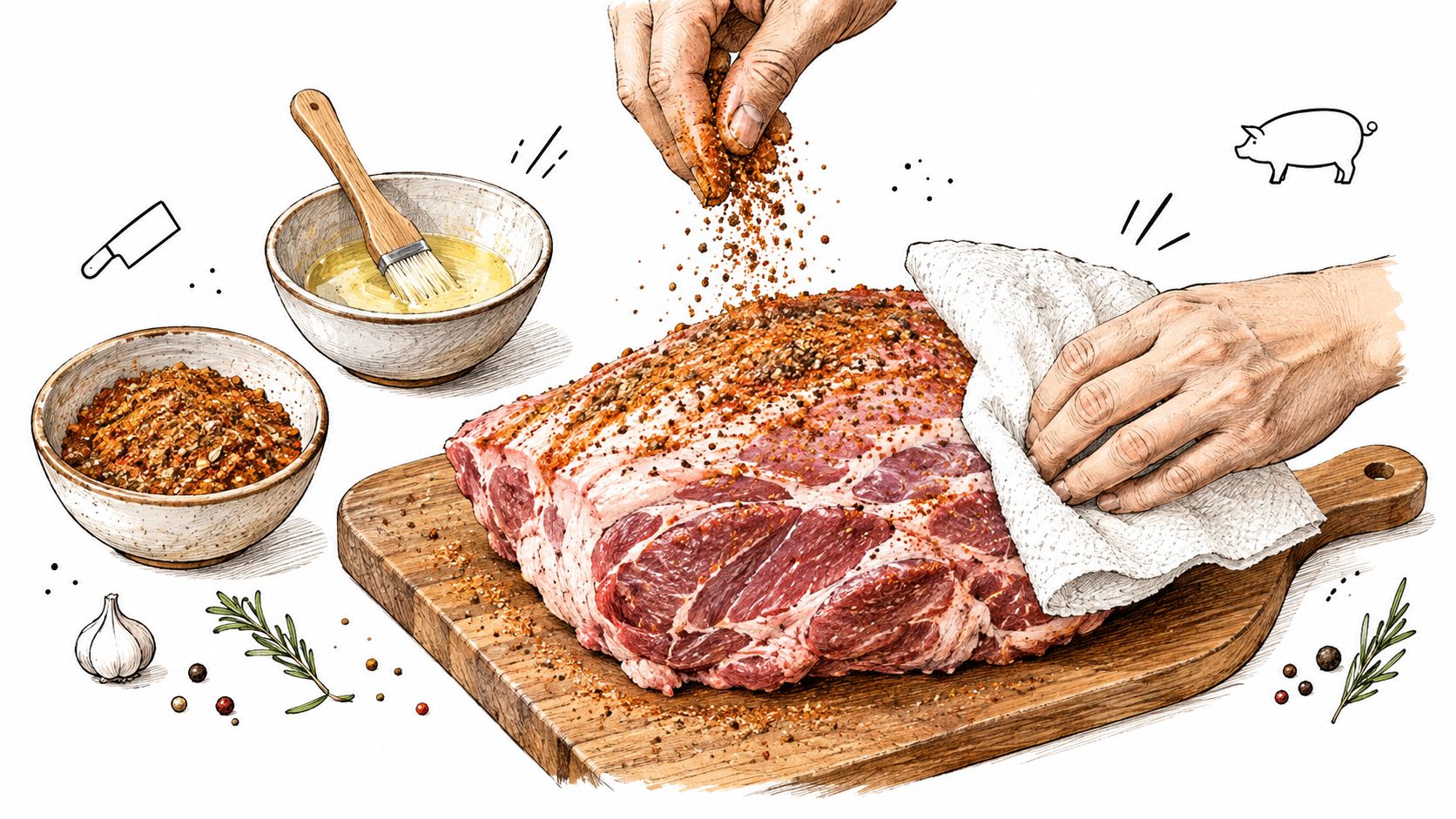
Dry pork gives you a better starting point than wet pork. Remove the shoulder from its packaging, pat it thoroughly with kitchen paper and leave the surface clean. Don't rinse the meat. Rinsing spreads raw-meat contamination around the sink and doesn't improve the bark.

A simple application method
- Choose the binder. Yellow mustard is a practical UK choice. It helps the rub cling to the meat and its sharpness fades during cooking. Use olive oil if you're avoiding mustard, or water when working with a low-sugar blend.
- Cover every face. Press the rub into the shoulder rather than flicking it over the top. Work around the sides, folds and any exposed seams.
- Rest the joint. Cover it and refrigerate it before cooking. Overnight seasoning is convenient, but the important point is to give the salt time to work without leaving the meat uncovered in the fridge.
- Take the chill off. Bring the shoulder out before cooking so it isn't going straight from a cold fridge into the heat.
Use enough seasoning to create an even coating, not a thick paste. The exact amount depends on the rub's salt level and the size of the joint. If the label lists salt near the top, apply more cautiously and add seasoning after pulling only if the meat needs it.
Bark forms best while the surface sits in a controlled range around 135°C to 165°C. Sugar-heavy rubs can scorch above 175°C, so start watching the colour once the cook has developed a dark crust. If the bark is darkening faster than the centre is tenderising, lower the heat or cover the joint.
A good bark looks dark and dry. It shouldn't taste like burnt sugar.
The rub is only one part of the bark. Surface moisture, airflow, cooker temperature and the amount of sugar all matter. A kettle with a clean indirect setup can produce excellent bark, while an oven may need the pork uncovered towards the end to dry the surface.
Use this pulled pork seasoning video as a visual reference for coating the meat and judging the starting texture.
Cooking Times, Temperatures, and the Pull Test
Pork shoulder is ready for pulling when the connective tissue has softened, not merely when the meat has reached a safe minimum. A safe target for pork is 70°C for 2 minutes, while slow-cooked shoulder is often taken towards 95°C for pull-apart texture, as explained in this UK pork temperature guide.
Pulled Pork Cooking Times by UK Setup
| Method | Temperature | Time per 450g | 2kg Shoulder Total | Pull Temp |
|---|---|---|---|---|
| Smoker | 107°C to 121°C | Long, low-and-slow cook | Often 8 to 12 hours | Around 95°C, then probe test |
| Indirect kettle | 107°C to 121°C | Similar to a smoker | Often 8 to 12 hours | Around 95°C, then probe test |
| Conventional oven | Around 150°C | Use tenderness rather than the clock | Around 4 to 5 hours may suit the joint | Around 95°C, then probe test |
| Fan oven | Around 135°C | Use tenderness rather than the clock | Cook until the shoulder is probe-tender | Around 95°C, then probe test |
| Air fryer | Around 180°C for reheating | Not suitable for the first cook | Warm shredded, cooked pork | Heat through thoroughly |
The smoker and kettle need steady indirect heat. Bank the charcoal away from the pork, keep the lid closed as much as possible and manage the fire rather than chasing every small temperature movement. For the oven, cover the pork for the early part of the cook if you need to protect it from drying, then uncover it to firm the bark.
Waitrose's UK roast pork guidance gives a low-oven approach around 150°C and a 4–5 hour window for a 2kg joint, with the meat cooked until it pulls apart easily. Treat that as a useful planning point, not a promise. Shoulder shape, bone, fat and your oven all change the finish time.
Probe the thickest part and avoid the bone, fat and gristle. These areas can distort the reading. The UK guidance on checking cooked pork makes the important distinction between a safe temperature and meat that is tender enough to pull.
Rest the cooked shoulder before shredding it. Keep it wrapped and insulated, then pull it with forks or gloved hands, separating large pieces of fat while keeping the bark mixed through the meat. If it resists, it needs more cooking, not more sauce.
For a fuller temperature reference, use this pulled pork temperature guide alongside a reliable probe thermometer.
Pairings, Sauces, and Wood Pellet
Rich pork needs contrast. If the rub is sweet, serve something sharp. If it's smoky, add freshness. If it's hot, bring in a cooling side rather than trying to fight the chilli with more sugar.
Pulled Pork Pairings at a Glance
| Rub Profile | Best Sides and Sauce | Wood Pellet |
|---|---|---|
| Sweet Southern | Creamy slaw, cornbread, pickled red onion | Fruitwood |
| Smoky and savoury | Pit beans, brioche buns, bourbon-style glaze | Hickory |
| Citrus-forward | Charred corn, pineapple salsa, fresh herb sauce | Mild fruitwood |
| Chilli-hot | Buttermilk slaw, pickles, vinegar mop | Oak |
For a kettle cook, choose a seasoning with enough savoury depth to sit beside charcoal and fruitwood smoke. A pork-focused blend such as Hickory Hog Pork Rub is the practical route when you want the seasoning to support the meat rather than turn the sandwich into a novelty.
Citrus-style seasoning belongs with lighter sides. Charred corn and pineapple salsa cut through rendered fat, while a herb sauce keeps the plate from becoming heavy. Hot rubs need the same discipline. Put cool slaw on the bun, add a vinegar mop and let the pork carry the heat.
Don't choose pellets as an afterthought. Hickory adds a firm, recognisable smoke, oak gives a stronger backbone and fruitwood keeps the profile gentler. The cooker still matters, so read the pellet guidance before loading the hopper or adding fuel to a kettle.
Serving rule: Match the sauce to the rub's weakness. Use vinegar against sweetness, freshness against smoke and dairy against chilli.
You can compare the available wood pellets for UK BBQ cooking before committing to a full cook. For a straightforward shopping list, pair Hickory Hog Pork Rub with your chosen pellets and a sauce that brings acidity rather than another layer of sweetness.
Buying, Bundling, and Gift Sets
Buy a single tin when you already know your flavour direction. Choose a bundle when you're still testing what works in your oven, kettle or smoker. That's the sensible distinction, and it saves you from filling the cupboard with seasoning you won't use.
A pouch suits regular cooks because it takes less shelf space and can be resealed between uses. A tin or shaker is convenient at the grill. Don't get distracted by pack size alone. A larger format only offers value if you cook often enough to use it while the spices are still lively.
For a first pulled pork purchase, start with a pork-specific seasoning and keep the rest of the meal simple. The Pork Essentials 4-Pack is aimed at cooks who want more than one pork option, while the Build Your Own Bundle gives you control over the selection.
Gift buyers should match the present to the recipient. A broad selection works for someone who cooks chicken, beef, vegetables and pork. The Best Sellers Seasoning Gift Set is a straightforward choice, while the Bar-B-Que Heroes Bundle suits a committed outdoor cook.
Choose by cooking habit
- For pulled pork specialists: Pick the pork pack or a single pork rub.
- For a family kitchen: Choose a broader flavour set that can season vegetables and weeknight meals as well as barbecue.
- For a hot-food fan: Look at the Chilli Heroes Bundle.
- For a mixed grill household: Consider the Flavour Heroes Bundle.
Check delivery timing and allergen information before ordering, especially for a birthday, Christmas meal or planned weekend cook. A bundle is useful when it helps you cook more confidently, not when it only adds more jars to the cupboard.
Smokey Rebel offers UK-made small-batch rubs and seasonings, including pork-focused options, broader flavour bundles and wood pellets for outdoor cooking. Visit Smokey Rebel to choose a pulled pork rub that fits your cooker, your label priorities and the meal you're planning.
Join our Mailing List
Sign up and get Smokey Rebel Recipes + weekly recipes straight to your inbox!
Recent articles
Pulled Pork Rub UK: The Complete Buyer's Guide
Pulled Pork Rub UK. Find the best pulled pork rub in the UK. Compare flavour profiles, clean-label ingredients, cooking methods,...
Read moreTandoori Spice Rub: A Simple Guide for UK Cooks
Master tandoori spice rub with these tried-and-tested methods for homemade blends and store-bought shortcuts. Elevate every BBQ dish today.
Read moreHow to Smoke Chicken Thighs the Right Way
Learn how to smoke chicken thighs with step-by-step guidance on prep, rubs, wood, temperature, timing and resting for juicy UK...
Read more