How to Make a Dry Rub for Turkey That Actually Works
Piling on seasoning until the skin looks dark and heavily coated isn't the best way to make a dry rub for turkey. A strong crust can hide bland breast meat, burnt garlic and enough salt to overwhelm the gravy before anyone reaches for the stuffing.
The better approach is to weigh the salt, account for anything already added to the bird, and give it time to work. Keep the spices bold if you like, but judge the seasoning against the whole Christmas dinner, not a mouthful of skin.
Which Method Suits Your Turkey
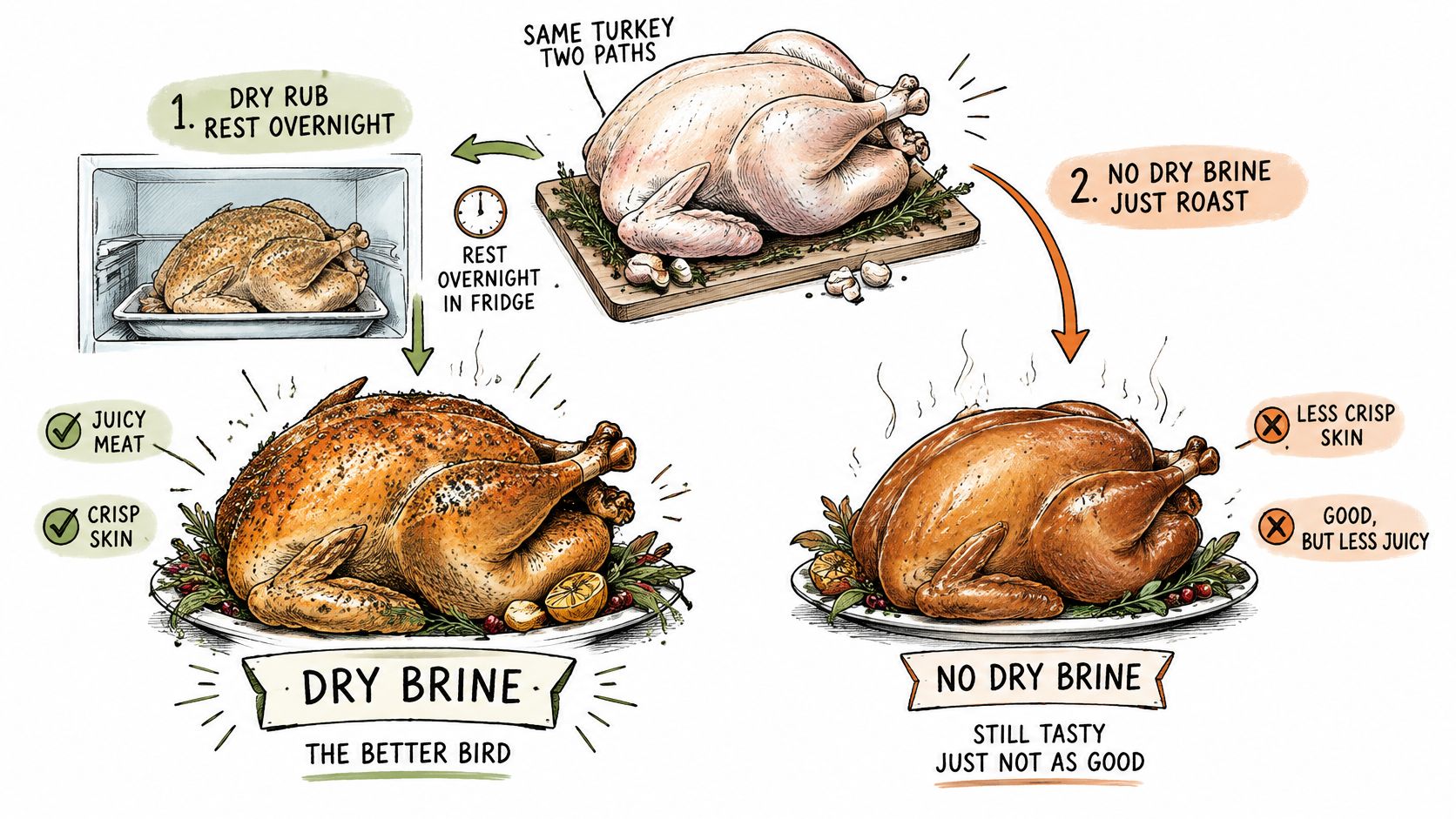
A same-day dry rub is the simplest route: no bucket, no soaking and little washing-up. For a typical oven-roasted Christmas turkey, though, I would choose a dry brine, applying the measured salt and seasoning ahead of cooking and letting the skin dry in the fridge.
Salt can move into the meat; most spice flavour stays nearer the surface. Giving the salt time to work improves seasoning beneath the crust, while exposing the skin to fridge air helps it dry before roasting.
Brine and rub methods compared
| Method | Time needed | Skin and moisture | Salt control | Best for |
|---|---|---|---|---|
| Wet brine | 12–24 hours soaking | Juicy meat, skin can stay soft | Hard to judge, easy to over-salt | Cooks with a cool larder and a large container, provided safe refrigeration is maintained |
| Dry brine (rub 1–2 days ahead) | 12–48 hours uncovered in fridge | Juicy meat, crisp skin | Easy, because salt is weighed against bird weight | Most home oven roasts |
| Same-day dry rub | 0–1 hour | Good crust, lighter seasoning depth | Flavour-led, light on salt | Smaller birds and last-minute cooks |
| Pre-brined or self-basting bird | None | Set by the producer | Check the label and cut added salt | Shoppers who bought a ready-prepared turkey |
These are practical preparation windows, not permission to exceed the bird's use-by date or storage instructions. A cool larder isn't automatically cold enough for raw poultry, so a wet-brining container still needs properly controlled refrigeration.
The difference between surface seasoning and advance salting is useful to picture before choosing your method.

Make room before buying the bird
Wet brining needs space for the turkey, liquid and a leakproof container. Dry brining needs less equipment, but you still need an open bottom shelf with enough clearance for the bird on its tray, away from ready-to-eat food.
Pre-brined, injected and self-basting birds need a different decision. Read the ingredients before opening the salt: you're adding flavour to meat that may already be seasoned, not starting from plain turkey.
Practical rule: With 24 hours and a fridge shelf, dry brine. With an hour, rub on the day and accept less depth of seasoning.
Salt and Spice Amounts for Any Bird Size
For an unbrined turkey, a practical dry-brining recipe uses salt at about 0.5–0.8% of bird weight, plus roughly a teaspoon of salt-free spices per kilogram. Treat the upper end as a ceiling, not a target, especially when the meal includes salty stuffing, stock and gravy.
Weigh salt in grams rather than spoonfuls. A teaspoon of fine table salt can weigh roughly twice as much as a teaspoon of loosely packed flaky salt, so changing salt type without weighing it can change the result substantially.
Salt and spice amounts by turkey weight
| Bird weight | Salt (0.5–0.8% of weight) | Salt-free spices (about 1 tsp per kg) | Dry-brine time in fridge |
|---|---|---|---|
| 3 kg | 15–24 g | 3 tsp | 12–24 hours |
| 4.5 kg | 22.5–36 g | 4½ tsp | 12–24 hours |
| 6 kg | 30–48 g | 6 tsp | 24–48 hours |
| 8 kg | 40–64 g | 8 tsp | 24–48 hours |
These are recipe quantities for plain birds, calculated from their weight. They aren't suitable as an additional salt allowance for a pre-brined or self-basting turkey.
Build flavour without increasing salt
Use paprika for warmth and colour, black pepper for bite, garlic granules for savoury depth, and dried thyme or sage for a Christmas-roast character. Finely grated lemon or orange zest adds lift without making the mix hotter or saltier.
For example, a salt-free spice mix for a plain bird could combine paprika, garlic granules, pepper and thyme, with zest added just before application. Keep the herbs finely crumbled so you don't leave coarse, woody patches on the skin.
The NHS salt guidance advises adults to consume no more than 6 g of salt daily and suggests herbs, spices, garlic, chilli, pepper and lemon as alternatives to added salt. The weighed amount applied to a whole bird isn't an individual serving allowance, but it still needs to make sense alongside everything else on the plate.
Count salt already in the blend
Check the salt figure on ready-mixed seasonings. A salty base blend replaces some or all of the measured salt; it doesn't sit on top of the full allowance.
If a label gives sodium rather than salt, don't treat the figures as interchangeable. Choose a product with a clear salt declaration or check the manufacturer's information before calculating your batch.
The dry chicken brine guide is useful for practising measured salting on a smaller roast. For Christmas turkey, choose the lower half of the recipe range when the accompaniments are already well seasoned.
How to Prepare and Rub a Whole Turkey
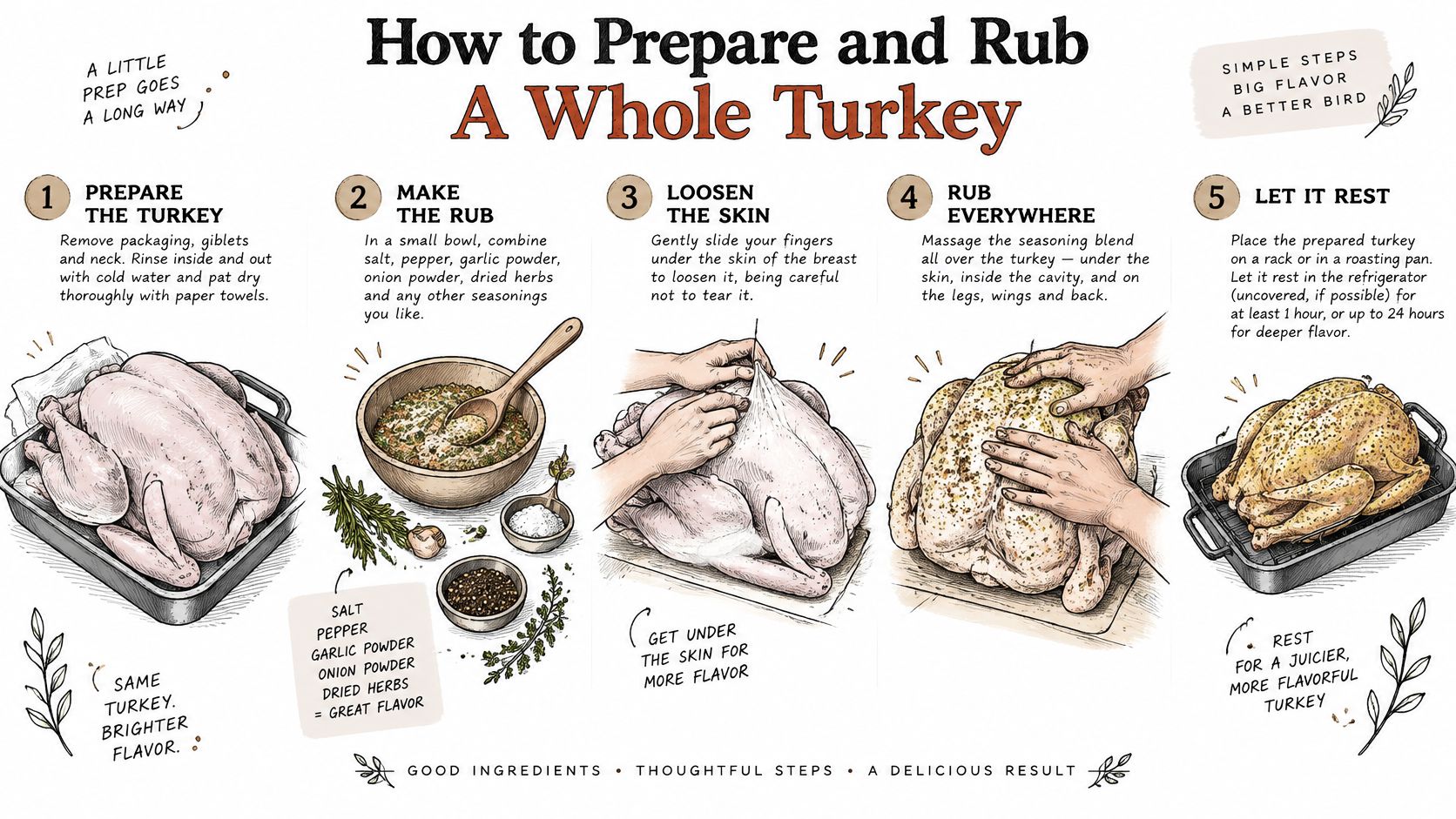
Set out a rimmed tray, rack, digital scales, disposable kitchen paper and a small seasoning bowl before handling the turkey. Decant the rub first so raw-poultry hands never touch the main seasoning container.
This preparation guide shows the order of work.

Prepare a dry surface
- Thaw fully in the fridge. The GOV.UK Christmas food hygiene guide advises refrigerator defrosting on the bottom shelf, where liquid can't drip onto other food. Keep the turkey contained while thawing; a partly frozen centre also makes seasoning and cooking less predictable.
- Remove packaging and giblets. Check the main cavity and neck opening, then put packaging straight into the bin. Keep anything intended for stock contained and refrigerated separately.
- Don't wash the turkey. Rinsing splashes raw-poultry contamination onto hands, utensils and worktops rather than making the bird safe. Clear the sink area of ready-to-eat ingredients before starting preparation.
- Pat the skin dry. Use disposable kitchen paper around the wings, thighs and underside as well as the breast. Loose surface water turns the seasoning into a slippery paste and encourages uneven browning.
Apply an even coating
- Weigh and mix the seasoning. Combine the salt and spices thoroughly before they touch the bird. Break up lumps so you don't leave concentrated pockets of salt.
- Work over and beneath the skin. Spread the rub evenly over the outside, then gently ease some beneath the breast skin where it separates without tearing. Reach into the folds around the legs, but don't force a thick layer into every crevice.
- Refrigerate on a rack over a tray. Leave the seasoned bird uncovered for its drying period only where it's protected from contact and contamination, within its labelled storage life. Wash hands, then clean and sanitise the scales, worktop and anything touched during preparation.
For a moving demonstration of handling and application, use the video alongside that routine.
The common slip is rubbing a visibly damp bird and trying to fix it with more seasoning. That usually creates heavier patches rather than better coverage.
Before roasting, aim for an even, dry, matte coating with no loose heaps of salt. A dry-brined bird may look damp initially as the salt dissolves; that isn't the same as leaving packaging liquid on the skin.
Don't rinse off the finished dry brine. If you've measured it correctly, the seasoning is intended to stay on the bird.
Cooking Times for Oven, Smoker and Grill
Oven roasting times by turkey weight
| Turkey weight | Oven time (180°C conventional) | Approximate total time |
|---|---|---|
| 4 kg | 45 min per kg + 20 min | 3 hr 20 min |
| 5 kg | 40 min per kg | 3 hr 20 min |
| 6 kg | 40 min per kg | 4 hr |
| 7 kg | 35 min per kg | 4 hr 5 min |
| 8 kg | 35 min per kg | 4 hr 40 min |
Follow the retailer's instructions first; when none are supplied, the GOV.UK fallback schedule reproduced in the Food Standards Agency turkey guidance uses 180°C conventional or 160°C fan, with 45 minutes per kilogram plus 20 minutes below 4.5 kg, 40 minutes per kilogram at 4.5–6.5 kg, and 35 minutes per kilogram above 6.5 kg. The same guidance recognises 75°C for 30 seconds as a safe centre temperature-time combination.
The table totals are planning estimates calculated from that schedule, not proof of doneness. Set a reminder to start checking about 30 minutes before your estimated finish, and allow extra time if the probe shows the centre still needs cooking.
Use indirect heat outdoors
For a smoker or kettle grill, a practical starting setting is around 150–160°C, with the turkey away from direct flame and the lid closed. Use a drip tray to catch fat, maintain airflow, and avoid repeatedly opening the lid to inspect the crust.
Choose food-grade fuel from the wood pellets collection if your cooker uses pellets. Add smoke cautiously: turkey breast has a mild flavour, and heavy smoke can overwhelm the herbs and gravy.
For an oven-based alternative, you can browse hickory smoke seasoning from Saporia and follow its label for use. Liquid smoke supplies flavour, not the cooking conditions of a smoker, so it doesn't change the need for proper temperature checks.
Let the probe decide
Smoker and grill timings change with weather, cooker stability, bird shape and lid opening, so a fixed outdoor timetable would be misleading. Dark spices and sugar can produce a finished-looking surface before the meat is ready.
Use a calibrated probe in the thickest breast and the thick meat between breast and leg, avoiding bone. The guide to using a meat thermometer explains placement and clean handling.
Rest the safely cooked turkey for 30–45 minutes under loose foil before carving. Carry-over heat may raise the centre further, but don't remove an undercooked bird and assume resting will make it safe; tight foil also traps steam and softens the skin.
Troubleshooting Burnt, Bitter or Bland Rubs
A dark, sugar-heavy crust over an undercooked centre is the problem to address first. Don't carve it because the skin looks ready, and don't keep exposing an already bitter surface to fierce heat.
Coventry City Council's Christmas food safety advice gives 70°C for 2 minutes, or an equivalent approved combination, as the centre-temperature check and advises probing away from bone. Surface colour, including the colour of the rub, can't establish that the thickest meat is safely cooked.
Dry rub problems, causes and fixes
| Symptom | Likely cause | Fix |
|---|---|---|
| Dark, bitter crust before the centre is cooked | Sugar and dark spices burn at high heat | Tent with foil, lower the oven by about 20°C and probe the thickest meat |
| Skin looks done but meat is pink near the bone | Surface colour is not a safety test | Probe the thickest meat away from bone and reach the temperature-time endpoint stated above |
| Rub falls off or forms wet patches | Damp skin when the rub went on | Pat dry before rubbing and reapply lightly to bare patches |
| Bland meat under the skin | Rub only on top | Slide the rub under the breast skin and into the leg joints |
| Over-salted gravy or meat | Salty rub plus stock, stuffing or a pre-brined bird | Halve the salt next time and read the label on any pre-brined bird |
| Soft, pale skin | Rub applied too late, with no drying time | Rest uncovered in the fridge and, if the meat still needs cooking, increase heat for the final 20 minutes |
Rescue the roast without chasing colour
Loose foil shields the skin without sealing the whole bird into a steamy parcel. Reducing the heat buys the centre more cooking time, but it also pushes back the finish, so warn anyone organising the vegetables.
Bitter or acrid seasoning usually needs a recipe change next time. Reduce sugar, keep fresh minced garlic away from exposed high-heat surfaces, and use garlic powder sparingly rather than assuming dried garlic can't burn.
Fix seasoning at the right stage
If gravy tastes too salty, stop reducing it and extend it with unsalted liquid. Taste before adding stock cubes or seasoning, because concentrated pan juices can already carry plenty of salt.
Bland breast meat needs better salt distribution, not another heavy dusting over cooked skin. Applying seasoning beneath the breast skin helps place flavour where each carved slice will pick it up.
Finish-line check: The thermometer decides when the turkey is cooked. Rub colour only tells you how the surface is progressing.
Flavour Pairings That Work With Turkey
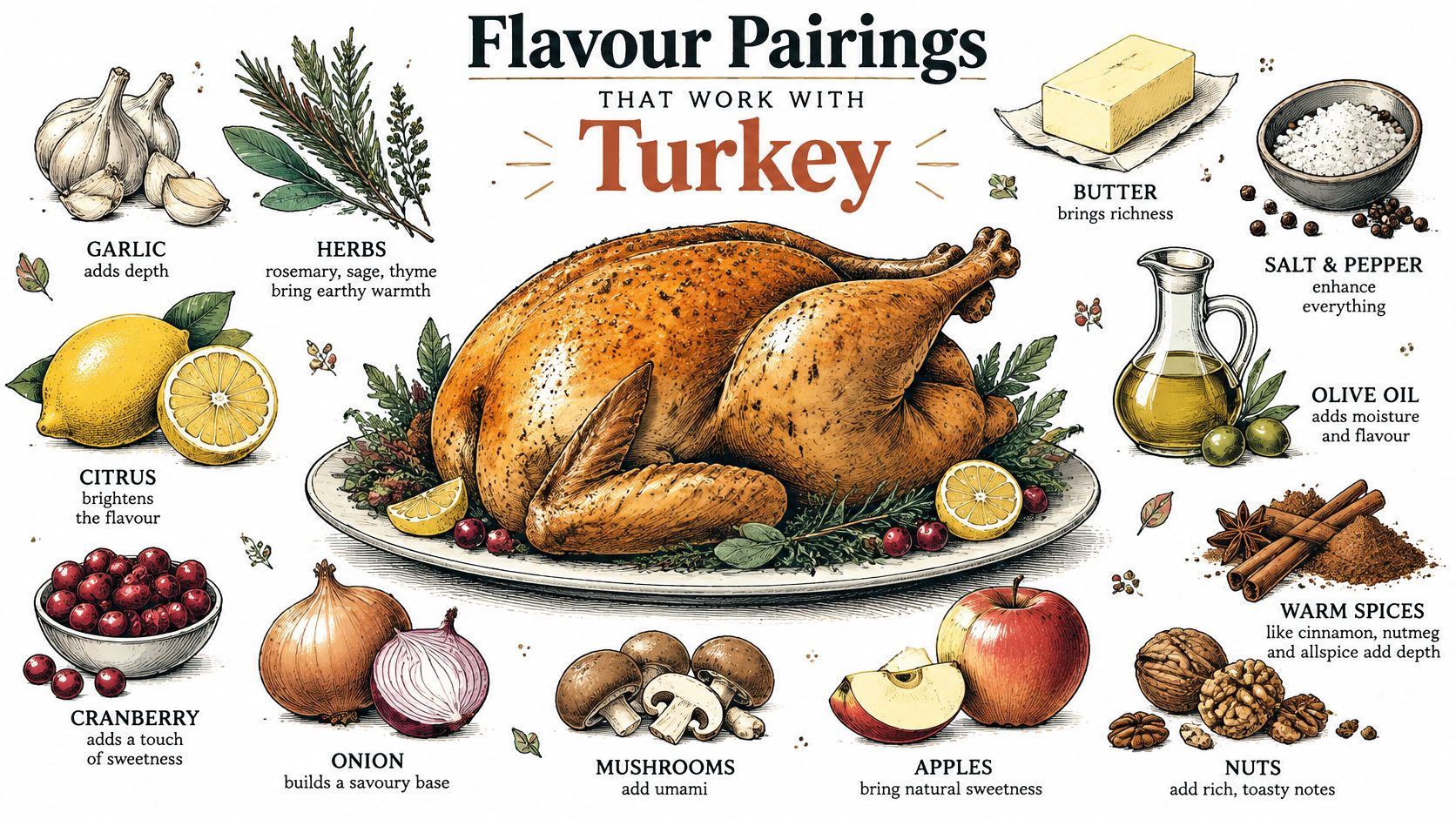
SPG Base Blend gives you salt, pepper and garlic without committing the roast to a sweet barbecue finish. Count its salt within your measured allowance, then use herbs, citrus or chilli to suit the rest of the menu.
The quantities below are mixing examples per 100 g of SPG Base Blend, not instructions to apply the entire batch to a turkey. Make only what you need, or keep the unused dry portion separate before handling raw meat.
Choose a direction for the meal
- Traditional Christmas roast. Add 1 tsp dried thyme, 1 tsp finely grated lemon zest and ½ tsp extra black pepper. A little crumbled sage can replace some thyme; the herbal flavour suits roast potatoes and stuffing without competing with cranberry sauce.
- Smoker or grill. Add 1 tsp smoked paprika and ½ tsp brown sugar. The Hickory Hog Pork Rub profile offers another route towards barbecue flavour, but use it as an alternative seasoning rather than automatically stacking salty blends.
- Mexican-inspired roast. Add 1 tsp ground cumin, ½ tsp chilli and 1 tsp orange zest. Chipotle Cowboy Chicken Rub is another option for a chilli-led direction; orange lifts the richer spice notes without needing more salt.
The pairing guide helps match those directions to the meal.

Test a little seasoning on a small piece of meat cooked thoroughly in a pan before rubbing the bird. Don't taste a raw-poultry mixture, and don't judge the blend by eating concentrated dry seasoning.
Paprika and sugar can darken quickly, so reduce either when roasting above 180°C. Keep chilli and sweetness restrained if you want leftovers that work equally well in sandwiches, curries and pies.
Plan Your Countdown and Leftovers
With 24–48 hours and a free bottom shelf, choose the dry-brine route. With less time, apply a same-day rub rather than trying to accelerate seasoning on the kitchen worktop.
Count back from serving
For a 6 kg turkey, use this worked Christmas-day plan, adjusting it to the retailer's instructions and your probe readings.
- Before the seasoning window. Allow enough time for full fridge thawing according to the packaging. Two days before cooking, check that it's fully thawed, weigh it and calculate the seasoning; don't assume a frozen bird will thaw within that window.
- The day before. Apply your measured mix and refrigerate on its rack. If you're choosing different flavours for the turkey and sides, the Build Your Own Bundle page lets you select them separately.
- On the day. In this example, plan about 4 hours at 180°C conventional, begin probing about 30 minutes before the estimate, then allow 30–45 minutes for resting.
For a larger menu, the Christmas Feast BBQ Rub Gift Set offers seasonings for other dishes without making the turkey carry every flavour.
FAQs
How long can cooked turkey stay in the fridge?
Dover District Council's turkey guidance advises keeping the fridge below 5°C, eating refrigerated cooked turkey within two days, or freezing portions within one to two hours of cooking; defrosted leftovers should be eaten within 24 hours and shouldn't be refrozen.
What should I make with the remaining meat?
Portion it promptly into shallow containers, keeping only what you'll use soon refrigerated. Try leftover turkey carnitas for a different meal, and reheat the turkey until steaming hot throughout.
Smokey Rebel offers small-batch seasonings inspired by authentic cultural flavours, with plant-based ingredients, no fillers and a “no added crap” approach, packed in recyclable craft cans. Visit Smokey Rebel to choose a balanced turkey seasoning, explore bolder flavours for the sides, or put together a Christmas cooking gift.
Join our Mailing List
Sign up and get Smokey Rebel Recipes + weekly recipes straight to your inbox!
Recent articles
How to Make a Dry Rub for Turkey That Actually Works
Learn how to make and apply a dry rub for turkey, with salt ratios by bird weight, oven times, safe...
Read moreSeasoning for Chicken Wings: A Step-by-Step Guide
Seasoning for chicken wings made simple: rub amounts, resting times and safe temperatures for oven, grill, air fryer and smoker.
Read moreHow to Grill Fish: Times, Temperatures and Methods
Learn how to grill fish with timing charts for salmon, cod, mackerel and prawns, gas and charcoal setup, and simple...
Read more