How to Smoke a Briskt in a Smoker for Perfect Results
Smoking a brisket is a true rite of passage in the world of barbecue. It’s the ultimate test of patience and skill, turning one of the toughest cuts of beef into something unbelievably tender and packed with authentic flavour.
There's no big secret. It all comes down to three things: seasoning it well with all-natural rubs, holding a low and steady temperature for hours, and letting it rest properly before you even think about slicing. It's a long game, but the payoff is legendary.
The Journey to Flawless Smoked Brisket
Welcome to the definitive guide for anyone in the UK looking to conquer the king of low-and-slow cooking. This isn't just another recipe; it's a deep dive into the craft, sharing the real-world tips that separate a decent brisket from a truly great one.
We'll walk you through the entire process, step-by-step, explaining the 'why' behind everything. From picking the right cut to making that first perfect slice, you'll get the confidence to nail it every single time.
Here’s what we’ll cover:
- Choosing the Right Cut: How to spot a quality 'packer' brisket with the marbling that guarantees a juicy finish.
- Seasoning for Maximum Impact: The secret to building that deep, dark bark that locks in moisture and authentic flavour.
- Mastering Smoker Temperatures: Keeping that low-and-slow environment consistent is everything. We’ll show you how.
- Navigating the Infamous 'Stall': What it is, why it happens, and how to push through it without drying out your brisket.
- The Crucial Final Steps: Nailing the rest and learning to slice against the grain for maximum tenderness.
The Rise of UK Barbecue
Let's be honest, the art of smoking brisket has exploded across the UK. You see it everywhere now. In fact, sales of proper grilling equipment and accessories have shot up by around 25% in the last few years. It's clear we've all caught the barbecue bug.
Since 2020, interest in low-and-slow smoking, in particular, has jumped by over 40% in some parts of the country. A proper brisket cook now averages between 1 to 1.5 hours per pound. If you want to dig into the numbers, you can find more insights on the growing brisket market over on knowledge-sourcing.com.
The secret to a great brisket isn't some magic trick. It's the sum of many small, well-executed steps—from the trim to the slice. Each one builds on the last to create the final masterpiece.
Whether this is your first brisket or you're just looking to sharpen your skills, this guide is your roadmap. We’ll skip the confusing jargon and stick to practical, repeatable advice that works in a real British back garden.
Get ready to create a brisket with a perfect bark, a beautiful smoke ring, and that tender, juicy texture everyone craves.
Choosing and Trimming Your Brisket Like a Pro
The journey to an incredible smoked brisket starts long before you light the smoker. It begins at the butcher's counter. The quality of meat you choose is genuinely the most important step in this whole process – it sets the stage for everything that follows.
Your best bet is to find a whole ‘packer’ brisket. This is the entire cut, containing two distinct muscles: the leaner ‘flat’ and the richer, fattier ‘point’, all joined by a beautiful layer of fat. You’ll usually find them vacuum-sealed. While you might be tempted by smaller, pre-trimmed flats, try to avoid them. That point muscle is a goldmine of moisture and flavour that you really don't want to miss out on during a long cook.
When you're at the shop, don't be shy about getting your hands on the meat. A good brisket should have a bit of flexibility. If you can pick it up from the centre, it ought to have a decent bend or ‘flop’ to it. A brisket that’s stiff as a board is a sign it might not cook as evenly, so I tend to leave those behind.
What to Look For in a Quality Brisket
When it comes to low-and-slow cooking, marbling is your absolute best friend. I'm talking about that intramuscular fat – the thin white flecks and lines running through the meat itself. As the brisket smokes, all that fat renders down, basting the muscle from the inside out and guaranteeing every slice is dripping with flavour and juice.
So, get a good look at it. You want to see consistent, even marbling all the way through the flat. A thick fat cap on top is great, but the real magic is the fat inside the muscle.
Next, have a good look at the flat. This is the longer, leaner part of the brisket. You’re looking for one that has a fairly uniform thickness from one end to the other, ideally at least an inch thick all the way across. If one end tapers off and gets really thin, that bit will almost certainly dry out and overcook long before the thicker point is done.
The Art of Trimming a Brisket
Right, you’ve got your brisket home. Now it’s time for the trim. This isn’t about hacking off all the fat; it’s more like sculpting. The goal is to shape the meat for an even cook and create an aerodynamic profile that helps the smoke flow over it perfectly. Think of it as preparing the canvas for your rub and smoke.
I always find it’s best to work with a cold brisket straight from the fridge. The fat will be firm and much easier to slice cleanly. A sharp, flexible boning knife is the tool for the job here – it gives you the control you need.
Here’s a practical, step-by-step approach to trimming:
- Step 1: Trim the Fat Cap: Place the brisket fat-side up. Trim that thick layer of fat down to a consistent ¼-inch (about 6mm). This is crucial for protecting the meat without blocking the rub and smoke.
- Step 2: Remove Hard Fat: Feel for any hard, waxy chunks of fat, especially the big 'deckle' of fat between the point and the flat. This won't render properly, so trim it out carefully.
- Step 3: Shape for Airflow: Round off any sharp corners on the brisket. Slice away any thin, dangly bits of meat or fat from the sides, as these will just burn. Aim for a smooth, rounded shape that helps the smoke and heat circulate evenly.
Proper trimming is non-negotiable. It leads to an even cook, a much better bark, and stops parts of your brisket from becoming dry or overly fatty. Spending an extra 15 minutes on this will pay off massively hours later.
And don't just chuck all your trimmings! That clean, trimmed fat is perfect for rendering down into beef tallow. It’s an incredible cooking fat, and loads of pitmasters (myself included) use it to baste the brisket later in the cook. Getting this prep right is the first secret weapon in your BBQ arsenal.
Building an Epic Flavour Foundation

With your brisket trimmed and ready, it’s time to build the flavour armour. This is where you create the foundation for that dark, crunchy, and intensely savoury crust we all know and love as the 'bark'. Don't rush this part; it's what defines the final taste.
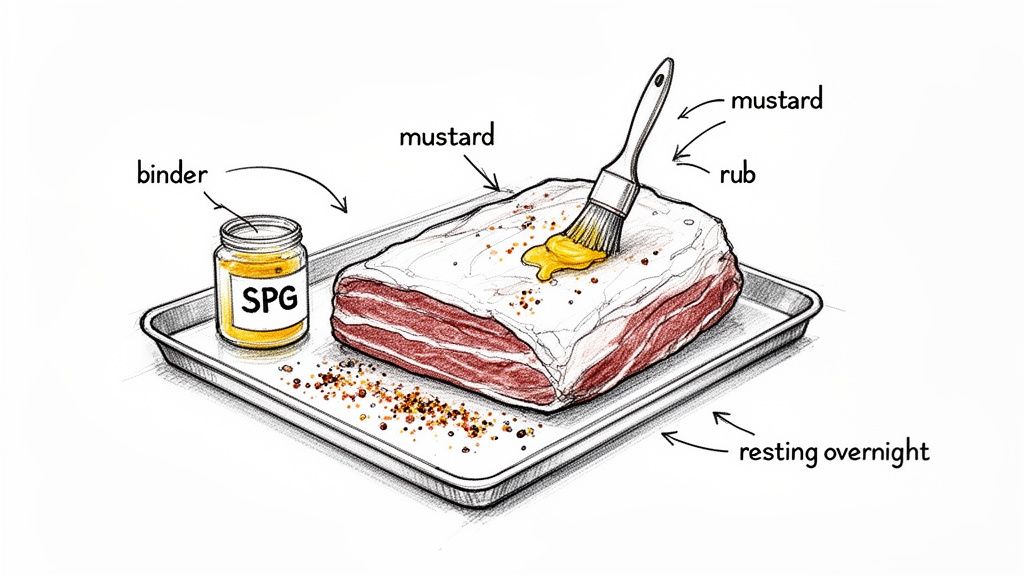
First up, the binder. This is just a thin layer that helps the rub stick properly, giving you that perfect, even coating. We’re not trying to add a dominant flavour here, just looking for adhesion.
A thin slather of classic yellow mustard is the go-to for many pitmasters. And don't worry—that vinegary tang cooks off completely, leaving no trace in the final product. If mustard isn't your thing, a light coat of olive oil or even a bit of hot sauce works just as well. The trick is to apply a very thin, even layer across the whole brisket.
Choosing Your Signature Rub
Now for the main event: the seasoning. The rub works with the smoke to create that iconic brisket bark. A cut as rich as brisket doesn't need to be overwhelmed. In fact, most legendary briskets are built on simple, bold flavours that just make the beef taste more like itself.
For that timeless, authentic Texas-style flavour, you really can't beat a straightforward mix. A high-quality base rub with no added crap lets the meat do the talking. Our SPG (Salt Pepper Garlic) Base Blend is designed to create that perfect savoury, peppery crust that’s the hallmark of truly great brisket.
If you’re after something with more depth, consider a rub crafted specifically for beef. A blend like our Revolution Beef Rub is built to stand up to a long smoke, adding subtle notes that enhance the beefy profile without overpowering it. Remember, the smoke itself is a key ingredient, so choose a rub that complements it. To learn more, check out our guide on choosing the right smoked wood for your BBQ.
The Art of Application and Rest
Don't be shy with the seasoning. Brisket is a huge piece of meat, and it needs a generous coating to form a proper bark. I find it easiest to work in a large tray to contain the mess. Apply the rub evenly on all sides—top, bottom, and the edges. Pat it gently into the meat; there's no need to actually rub it in, as that can make it clump up.
The single most overlooked step in seasoning a brisket is giving it time. Letting it rest uncovered in the fridge overnight makes a world of difference. This is a simple dry-brine that lets the salt penetrate deep into the meat, drawing out moisture which then dissolves the rub to create a tacky, flavour-packed surface.
This overnight rest does two crucial things. First, it seasons the meat far beyond just the surface. Second, it's the secret to developing that incredible dark, rugged bark during the cook.
Recent consumer data shows that seasoning a brisket overnight can improve bark formation by up to 25%, while pitmasters using high-quality, all-natural seasonings report 35% better flavour retention. It’s a small investment of time that pays off in a huge way.
Mastering Your Smoker and Managing the Cook

Alright, this is where the real art of barbecue begins. Your brisket is prepped and seasoned to perfection, and now it’s time to hand it over to the fire. Patience is your best friend from here on out. Your only job is to create a rock-solid cooking environment and then trust the process.
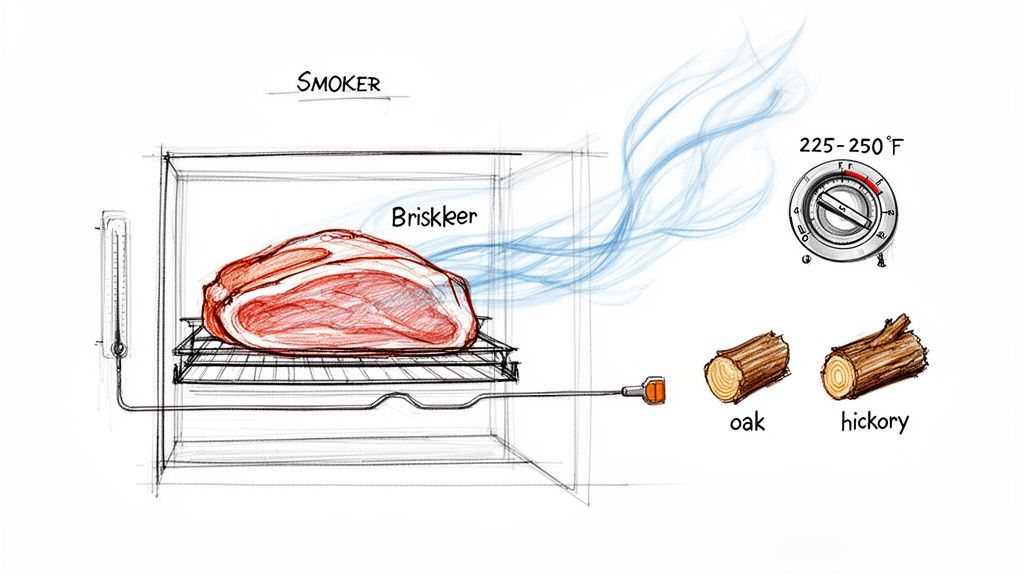
The magic number for smoking a brisket is somewhere between 107°C and 121°C (225°F to 250°F). Lock your smoker into that range and keep it there. If you run it too hot, the meat will toughen up. Too low, and you'll be cooking all night while your bark struggles to form.
It doesn’t matter if you’re running an offset, a pellet grill, or a kamado—get it dialled in before the brisket ever touches the grate. If you need a refresher, we've got a full breakdown on how to use a BBQ smoker in our comprehensive guide.
Achieving Clean Smoke
Think of wood as another ingredient. For a big, beefy cut like brisket, you need a wood with enough character to stand up to it without completely taking over.
- Oak: This is the undisputed king for a reason. It gives you a beautiful, medium smoke flavour that just works with beef.
- Hickory: A bit more assertive, hickory brings that classic, almost bacon-like smoke. It’s a strong flavour, so I often mix it with oak or a bit of fruit wood to mellow it out.
- Mesquite: Use this one with caution. It’s incredibly intense and can turn your brisket bitter if you overdo it. A little goes a very long way.
Forget what you’ve seen on TV. You’re not looking for thick, bellowing white clouds. The goal is a delicate, almost invisible wisp of thin blue smoke. That’s the sign of a clean, efficient fire, and it’s what will give your brisket that incredible, sweet smoke flavour instead of a harsh, ashtray taste.
Navigating the Infamous Stall
A few hours in, you'll see a gorgeous mahogany crust start to build. The internal temperature will be climbing steadily… and then, suddenly, it stops. Dead in its tracks.
Welcome to the stall.
This temperature plateau, usually kicking in around 65°C-74°C (150°F-165°F), can last for hours. Don't panic. This is completely normal and happens with every single brisket. It's just science—specifically, evaporative cooling. As moisture on the brisket's surface evaporates, it cools the meat down, fighting against the heat of your smoker.
Now, you have a decision to make. You can either power through it by wrapping the brisket, or you can ride it out.
Your choice during the stall defines the final texture of your brisket. Wrapping sacrifices some bark for speed and moisture, while waiting it out rewards the patient with the crunchiest crust. Neither is wrong; it's about matching the method to your desired result.
To Wrap or Not to Wrap
Pushing through the stall is a classic pitmaster’s dilemma. Each approach has its pros and cons, and your choice really comes down to what you're aiming for in the final product. Let's break down the two main camps.
Wrapping vs Not Wrapping During the Stall
| Method | Pros | Cons | Best For |
|---|---|---|---|
| Butcher Paper Wrap | Speeds up the cook significantly. The paper breathes, which helps preserve a decent bark texture. | Your bark will be slightly softer than if you didn't wrap at all. | The pitmaster wanting a great balance between a speedy cook and a quality crust. This is a very popular competition method. |
| Foil Wrap | This is the fastest way through the stall. It traps all the moisture, producing incredibly tender and juicy meat. | Say goodbye to your bark. The steam inside the foil will make it soft and wet. | Anyone prioritising pure tenderness and a quick cook time over a crunchy exterior. |
| No Wrap | Develops the absolute best bark possible—deep, dark, and with an unbelievable crunch. | This is the longest cook by far. It demands more attention to keep the smoker's environment stable. | The purists. If you believe the bark is the best part and you have the time to wait, this is your method. |
The "Texas Crutch," which is wrapping in foil or butcher paper, is a great tool for controlling your cook time and ensuring a moist result. But if you’re a bark fanatic, going "naked" and riding out the stall is the only way to achieve that ultimate crust. Try both and see which one you prefer—that's half the fun of barbecue.
The Critical Final Steps: Rest and Slice

You’ve spent the better part of a day tending the fire, riding out the stall, and coaxing that magnificent brisket to the finish line. Don't fall at the final hurdle. What you do next can make or break all that hard work in a matter of minutes.
Resting and slicing aren't just afterthoughts; they are just as important as the smoke itself.
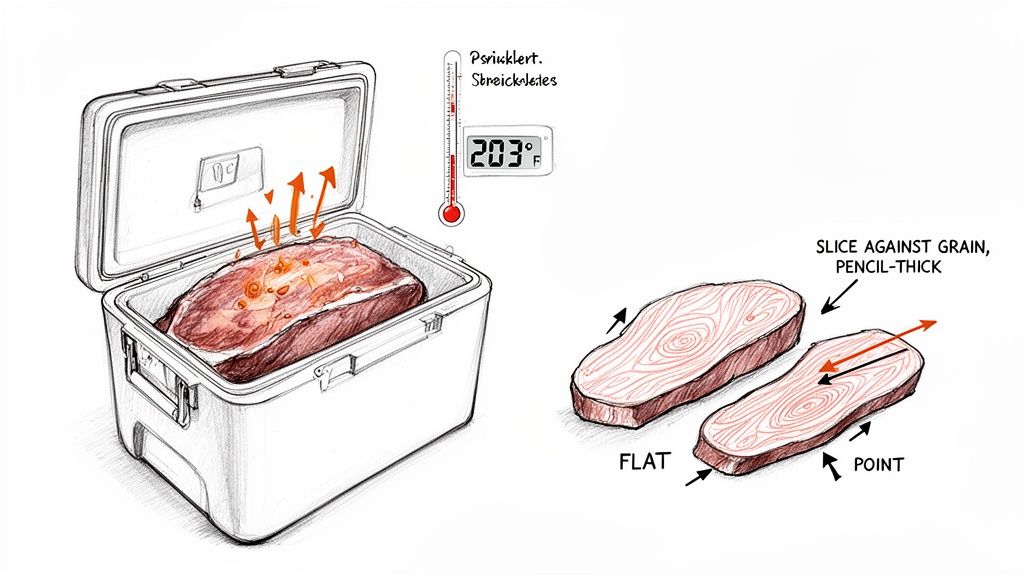
When your probe slides into the thickest part of the flat with almost no resistance—that famous "like pushing into a jar of peanut butter" feeling—it’s done. This "probe tender" texture is your true north. It often happens around 95°C (203°F), but trust the feel over the numbers. Pull it from the smoker immediately.
Why You Must Rest Your Brisket
And now for the hardest part: waiting. You absolutely have to let the brisket rest.
Over those long hours in the smoker, the muscle fibres have tightened up, pushing all the moisture towards the centre. If you slice into it straight away, all those glorious juices will pour out onto your cutting board, leaving you with dry, tough beef. It's a tragedy.
Resting lets the muscle fibres relax and reabsorb all that incredible moisture. This is what makes every slice succulent and packed with flavour. It's not a suggestion; it’s a non-negotiable rule of great barbecue.
A proper rest is the difference between a good brisket and a legendary one. Think of it as the final, gentle stage of cooking where the magic of tenderness and juiciness truly settles in. Skipping this is the single biggest mistake a new pitmaster can make.
How to Rest Brisket Properly
The goal is to let the internal temperature slowly come down while keeping the outside perfectly warm. The best way to do this is with an old-school barbecue trick: the faux Cambro.
- Vent it: If you've wrapped your brisket, open the foil or paper for 5-10 minutes. This lets the initial blast of steam escape, stopping the cook and preventing your beautiful bark from turning to mush.
- Prep the Cooler: Grab a standard picnic cooler and line the bottom with a couple of old, clean towels.
- Wrap and Rest: Re-wrap the brisket loosely, place it in the cooler, and lay another towel on top before shutting the lid.
- Be Patient: This insulated setup will keep the brisket at a safe temperature for hours. Aim for a rest of at least one hour, but honestly, the magic really happens between two to four hours.
This long rest is also a huge logistical advantage. It gives you a massive serving window, so you don't have to stress about timing everything to the minute your guests arrive. And if you want to get your temperatures spot-on every time, check out our guide on how to use a meat thermometer.
Slicing for Maximum Tenderness
After a well-deserved rest, it's time for the grand finale. How you slice a brisket is everything. This cut is made of two separate muscles—the lean 'flat' and the fattier 'point'—and their grains run in different directions. Slicing with the grain gives you chewy meat. Slicing against it creates that melt-in-your-mouth tenderness we’re all chasing.
First, find the thick ribbon of fat that separates the two muscles and carefully slice along that seam to separate the point from the flat. Now you have two manageable pieces.
Slicing the Flat:
- Look closely to see which way the muscle fibres are running.
- Turn your knife perpendicular to that grain.
- Cut the flat into uniform slices, about the thickness of a pencil.
Slicing the Point:
- This is the money muscle, rich with rendered fat and flavour.
- You can slice it against the grain just like the flat for intensely beefy, moist pieces.
- Or, for a real crowd-pleaser, cube it into 1-inch chunks, toss with a little BBQ sauce, and pop it back in the smoker for an hour to make legendary "burnt ends."
Take your time here. You've earned this moment. Serving up perfect slices of juicy, tender brisket is the ultimate payoff for a day of patience and dedication.
Common Brisket Questions Answered
Even when you have the perfect plan, a long brisket cook will always throw a few curveballs your way. Learning how to smoke a brisket in a smoker is a real journey, and believe me, every cook teaches you something new. This is where we tackle some of the most common questions that pop up, giving you straight answers when you're in the thick of it.
Think of this as your mid-cook troubleshooting guide. We’ve all been there, wondering about everything from the final temperature to whether we should have injected.
What Is the Best Internal Temperature to Pull My Brisket?
The number you'll hear everywhere is 95°C (203°F), but don't treat it as gospel. The real signal is what we call 'probe tenderness'. It’s a feel, not a number. When you slide a temperature probe into the thickest part of the flat, it should go in with almost zero resistance—like poking into a jar of room-temperature peanut butter.
This moment of perfect tenderness can happen anywhere between 92°C and 98°C (198°F to 208°F). Every single brisket is different, so you have to trust the feel. This is one of the biggest skills that separates good barbecue from truly great barbecue.
Your probe is your best friend. Don't pull the brisket just because the thermometer hits a certain number. Wait until it tells you it's ready by giving you zero fight.
Should I Inject My Brisket Before Smoking?
Injecting is an optional step, but it can be a great way to push extra moisture and flavour deep into the meat. Most injections are pretty simple, often just beef broth or melted beef tallow. It’s a technique that really comes in handy for leaner brisket flats, which have a tendency to dry out.
Honestly, though, a good quality, well-marbled brisket that's cooked patiently and rested properly will be incredibly juicy on its own. If you're just starting out, my advice is to forget about injecting for now. Focus on nailing your temperature control, your trim, and the all-important rest. Once you've got those fundamentals down, then you can start playing around with injections.
How Long Does It Really Take to Smoke a Brisket?
Ah, the classic question. The only real answer is: "it's done when it's done." There's just no getting around it.
A decent rule of thumb for planning is to allow 60-90 minutes per pound when smoking at 110°C (225°F), but you absolutely cannot rely on this. It's an estimate, nothing more. A 12-pound brisket could be ready in 10 hours, or it could take 16. So many things can affect the final time:
- The thickness and marbling of that specific cut.
- How well your smoker holds a consistent temperature.
- Whether you decide to wrap it to push through the stall.
- Even the weather can play a part.
Always, and I mean always, give yourself more time than you think you need. You can let a finished brisket rest for hours, but you can’t force it to cook faster without ruining it.
Fat Side Up or Fat Side Down When Smoking?
This is one of the great debates in barbecue, but the answer is actually pretty straightforward. It all depends on your smoker and where the heat is coming from.
The key is to use the fat cap as a shield.
- Heat from Below (Kettle, Kamado, Vertical Smokers): Go fat-side down. That thick layer of fat will protect the meat from the direct heat rising from below, stopping it from drying out or, worse, burning.
- Heat from Above (Offset Smokers): With an offset, many pitmasters swear by fat-side up. The thinking here is that as the fat renders, it bastes the brisket, dripping all that flavourful moisture down over the meat.
When in doubt, just figure out where the most intense heat is and put the fat cap between it and your brisket.
Beyond getting that perfect taste and texture, presentation is key. For some great tips on making your finished brisket look irresistible, whether it's for your family or your Instagram feed, this guide is worth a read.
At Smokey Rebel, we believe that legendary barbecue starts with incredible flavour. Our rubs are crafted with all-natural ingredients and no added crap, designed to help you create that perfect bark and deep, savoury taste every time. For a classic foundation, try our SPG (Salt Pepper Garlic) Base Blend, or take your beef to the next level with our Revolution Beef Rub.
Join our Mailing List
Sign up and get Smokey Rebel Recipes + weekly recipes straight to your inbox!
Recent articles
Unforgettable Spice Rub Recipes For Chicken You Can Master
Discover bold spice rub recipes for chicken that transform your grilling. From smoky BBQ to zesty citrus, our guide offers...
Read moreYour Guide to the Perfect Temp for Pulled Pork
Master your BBQ with our guide to the perfect temp for pulled pork. Learn the ideal internal temperature, smoker settings,...
Read moreHow to Smoke a Briskt in a Smoker for Perfect Results
Learn how to smoke a brisket in a smoker with our definitive guide. Master trimming, seasoning, temperature control, and slicing...
Read more